---
title: "Audience to Revenue: Publishing, Campaigns & CRM"
description: Learn how to connect publishing, campaigns and CRM into one audience to revenue strategy that closes the loop on attribution.
image: https://velocity.digital/hubfs/Copy%20of%20Velocity%20Blog%20Featured%20Images.jpg
---
[](https://velocity.digital/)
- [Home](https://velocity.digital)
- Our Culture
- [Why choose Velocity?](https://velocity.digital/why-choose-velocity)
- [Our Team](https://velocity.digital/our-team)
- [Careers](https://velocity.digital/jobs)
- Services
- Revenue Growth Engine
- [Digital Campaign Strategy & Lead Generation](https://velocity.digital/digital-campaign-strategy-lead-generation)
- [RevOps & Revenue Funnel Alignment](https://velocity.digital/revops-revenue-funnel-alignmentand)
- [CRM Implementation & Onboarding](https://velocity.digital/crm-implementation-onboarding)
- AI & Automation Services
- [Process & Workflow Automation](https://velocity.digital/process-and-workflow-automation)
- [AI Readiness Assessment & Strategy](https://velocity.digital/ai-readiness-assessment-and-strategy)
- Localised Marketing
- [Smart City Portals](https://velocity.digital/city-sites-joburg-and-pretoria)
- Resources
- [SMB Onboarding Packages](https://velocity.digital/crm-implementation-optimisation#SMB_Packages)
- [Blog](https://velocity.digital/latest-news)
- [Video Hub](https://velocity.digital/video-hub)
- [Events](https://velocity.digital/events)
[CONTACT US](https://velocity.digital/contact)
# From Audience to Revenue: How Publishing, Campaigns and CRM Work Together
- [Home](https://velocity.digital)
- [Blog](https://velocity.digital/latest-news)
From Audience to Revenue: How Publishing, Campaigns and CRM Work Together
*Your marketing team is building audiences, running campaigns, and filling the CRM. But somewhere between the first content click and the closed deal, the thread snaps. Revenue attribution becomes guesswork, and no one can say with confidence which activities actually drove pipeline.*
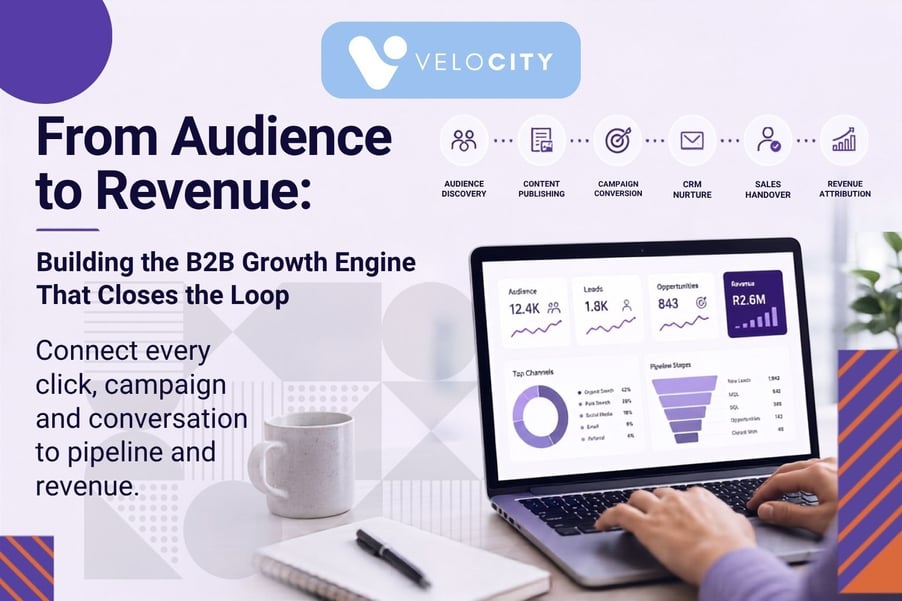
*This article maps the full audience to revenue strategy: from local audience discovery and content publishing, through campaign conversion and CRM nurture, to sales handover and multi-touch attribution. If you lead marketing or demand generation in a B2B organisation, this is the structural fix you have been looking for.*
## Covered in this article
[Why most B2B organisations never close the loop from audience to revenue](https://velocity.digital/latest-news/audience-to-revenue-strategies#section1)
[FAQs](https://velocity.digital/latest-news/audience-to-revenue-strategies#faqs)
## Why most B2B organisations never close the loop from their audience to revenue strategy
Most B2B marketing teams are good at building audiences. They publish content, run paid campaigns, grow social followings, and generate traffic. What they rarely do is connect any of that activity to revenue in a way that holds up to scrutiny.
The problem is structural. Publishing, campaigns, and CRM tend to operate as separate functions, each with its own tools, its own reporting, and its own definition of success. Content teams measure reach. Campaign managers measure clicks and conversions. Sales teams work from whatever lands in the CRM, often without knowing which campaign or piece of content brought that contact in.
The result is a broken chain. You can see audience growth at one end and closed deals at the other, but the middle is a black box. **Revenue attribution**, knowing which activities actually drove pipeline, becomes guesswork. Sales handovers are inconsistent because the context never travels with the contact.
This is the gap that a coherent **audience to revenue strategy** is designed to close. It is not a technology problem alone. It is a **[structural alignment problem](https://velocity.digital/latest-news/fix-roi-blind-spots-connect-online-and-offline-journeys)** between publishing, campaigns, and CRM, and it is more common than most teams want to admit.
## Building the bridge: from content publishing to lead generation

The first structural fix is treating digital publishing as a lead generation function, not a brand awareness exercise. Content that does not connect to a conversion path, a lifecycle stage in the CRM, or a campaign audience is content that cannot be attributed to revenue. That does not mean every article needs a hard sell. It means every piece of content needs a deliberate next step.
In practice, this starts with [identifying the content gaps](https://velocity.digital/latest-news/discovering-content-gaps-in-your-marketing-efforts) that exist between what your audience is searching for and what your current publishing covers. Localised marketing matters here: B2B buyers in different markets respond to different signals, different proof points, and different formats. A content strategy that ignores local context will generate traffic that does not convert, because the message does not match the buyer's specific situation.
Once the content is mapped to buyer intent, each asset needs to be connected to a campaign structure. That means UTM parameters on every link, landing pages that capture contact data into the CRM, and audience segmentation rules that fire the moment a contact engages. [Segmentation strategies](https://velocity.digital/latest-news/segmentation-strategies-for-super-targeted-email-marketing) built at this stage determine the quality of every nurture sequence that follows. Get this wrong and the CRM fills with contacts that sales will never trust.
## CRM implementation as the connective tissue for revenue growth
A CRM that is set up to receive contacts is not the same as a CRM that is set up to drive revenue. The difference is in how lifecycle stages, contact properties, and pipeline stages are configured to reflect the actual buyer journey, not a generic template.
Effective **CRM implementation** for an audience to revenue strategy means every contact record carries the full history of how that person engaged: which content they read, which campaign brought them in, which emails they opened, and where they are in the buying process. When that context travels with the contact into the sales handover, the conversation changes. Sales is no longer starting from scratch. They are continuing a conversation that marketing already started.
HubSpot is built for exactly this kind of connected architecture. Lifecycle stages, deal pipelines, and marketing automation workflows can be configured so that a contact moves from audience member to marketing qualified lead to sales qualified lead without anyone manually updating a spreadsheet. The [integration of CRM with other tools](https://velocity.digital/latest-news/how-to-integrate-crm-with-other-tools), including paid media platforms, email, and analytics, is what makes multi-touch attribution possible rather than theoretical.
For organisations that have accumulated messy data over years of disconnected activity, [cleaning and organising that data](https://velocity.digital/latest-news/declutter-your-data-simple-steps-for-better-organisation) is a prerequisite. Attribution models built on dirty data produce confident-looking numbers that are wrong. The audit comes before the strategy.
## Campaigns that convert: connecting digital activity to pipeline
Digital campaigns that drive revenue are not defined by click-through rates. They are defined by the quality of contacts they produce and the speed at which those contacts move through the pipeline. That requires a different briefing process, a different set of success metrics, and a different relationship between the campaign manager and the CRM.
The campaign brief needs to specify the target audience segment in the CRM, the lifecycle stage the campaign is designed to move contacts into, and the handover criteria that trigger a sales notification. Without those three elements, a campaign can perform well on paper and contribute nothing to revenue.
Localised digital campaigns add another layer of complexity and opportunity. Buyers in different geographies, sectors, or languages respond to different creative, different offers, and different proof points. A localised marketing approach, where campaign assets are adapted to the specific context of the target audience rather than translated from a global template, consistently produces higher lead quality and lower customer acquisition cost. The [combination of CRM and account-based marketing](https://velocity.digital/latest-news/tech-growth-engine-combining-hubspot-crm-and-abm-for-crm-and-abm-for-optimal-roi) is particularly effective here, because it allows campaign spend to be concentrated on the accounts most likely to convert.
Post-cookie tracking has made accurate campaign attribution harder, but not impossible. [Navigating the post-cookie environment with HubSpot](https://velocity.digital/latest-news/navigating-the-post-cookie-era-with-hubspot) means leaning on first-party data, CRM-based attribution, and server-side tracking rather than relying on third-party pixels that are increasingly blocked or degraded.
## RevOps: the operating model that holds the whole system together
Publishing, campaigns, and CRM can each be optimised in isolation and still fail to produce a coherent audience to revenue strategy. The missing layer is the operating model that governs how they connect. That is what RevOps provides.
Revenue Operations is not a job title or a software feature. It is the set of processes, governance rules, and shared metrics that ensure marketing, sales, and customer success are working from the same data, toward the same commercial outcomes. In a RevOps model, the definition of a qualified lead is agreed between marketing and sales before any campaign goes live. The handover criteria are documented. The attribution model is shared. The pipeline forecast is built on data that everyone trusts.
For marketing leaders, the practical implication is that RevOps requires you to have opinions about sales process and CRM configuration, not just campaign performance. For demand generation managers, it means your success metrics need to include pipeline contribution and revenue influence, not just lead volume. The [ROI blind spots that come from disconnected online and offline journeys](https://velocity.digital/latest-news/fix-roi-blind-spots-connect-online-and-offline-journeys) are a RevOps problem as much as a tracking problem.
Velocity's approach to RevOps is built around this principle: the technology should reflect the commercial strategy, not the other way around. HubSpot is a powerful platform, but a poorly configured HubSpot instance will faithfully automate a broken process. The strategic work comes first.
## Attribution: making revenue accountability real
Multi-touch attribution is the mechanism that closes the loop. It answers the question every CFO eventually asks: which of these marketing activities actually contributed to revenue, and by how much?
Single-touch attribution models, first touch or last touch, are easy to implement and almost always misleading. A B2B buyer who converts after six months of engagement with your content, three campaign touchpoints, and two sales calls did not convert because of the last email they received. A model that says they did will systematically undervalue content and overvalue late-stage tactics.
Multi-touch attribution in HubSpot allows you to distribute revenue credit across the touchpoints that actually influenced the deal. Combined with [clear data visualisation](https://velocity.digital/latest-news/data-visualisation-techniques-for-better-business-insights), this gives marketing leaders the evidence they need to defend budget decisions and redirect spend toward the activities that are genuinely driving pipeline. It also gives demand generation managers a feedback loop: if a particular content format or campaign type is consistently appearing in the attribution data for closed deals, that is a signal to do more of it.
The prerequisite, again, is clean data and a correctly configured CRM. [Common data collection mistakes](https://velocity.digital/latest-news/10-common-data-collection-mistakes-and-how-to-avoid-them) at the campaign or form level will corrupt the attribution model downstream. Attribution is only as good as the data it runs on.
## The next step for your integrated growth strategy
The gap between audience and revenue is not closed by adding more tools or running more campaigns. It is closed by building the structural connections between publishing, campaigns, CRM, and sales that allow context, data, and commercial intent to flow in one direction: toward a closed deal.
That means treating content as a lead generation function with measurable conversion paths. It means configuring your CRM to carry the full buyer journey into every sales conversation. It means running campaigns that are briefed against pipeline outcomes, not just click metrics. And it means adopting a RevOps operating model that gives marketing and sales a shared language for what success looks like.
If your organisation is ready to build that connected system, Velocity works with B2B marketing and revenue teams across Africa, Europe, and the Middle East to design and implement exactly this kind of integrated growth architecture, from CRM implementation and HubSpot configuration through to campaign strategy and revenue attribution. The conversation starts with an honest assessment of where your current system breaks down.
## FAQs
### **1. How do you convert a digital audience into paying customers?**
Converting a digital audience into paying customers requires connecting your content and campaign activity to a CRM that tracks each contact's journey from first engagement to closed deal. Every content asset needs a conversion path, whether that is a form, a gated resource, or a campaign landing page, that captures contact data and assigns it to the correct lifecycle stage. From there, marketing automation nurtures the contact with relevant content until they meet the agreed handover criteria for sales. The key is ensuring that context, which content they engaged with, which campaign brought them in, travels with the contact into the sales conversation.
### **2. What is the role of CRM in an audience to revenue strategy?**
The CRM is the connective tissue of an audience to revenue strategy. It is where audience data, campaign data, and sales data converge into a single contact record that reflects the full buyer journey. A well-configured CRM, such as HubSpot, allows marketing teams to segment audiences, trigger automated nurture sequences, and pass qualified leads to sales with full context intact. It also provides the foundation for multi-touch attribution, because every touchpoint is recorded against the contact and the deal. Without a properly implemented CRM, revenue attribution is guesswork and sales handovers are inconsistent.
### **3. How do digital publishing and lead generation work together?**
Digital publishing drives lead generation when content is mapped to buyer intent and connected to a conversion path. Each piece of content should serve a specific stage of the buyer journey and include a clear next step, whether that is a related resource, a form, or a campaign landing page. Localised content, adapted to the specific context of the target audience rather than translated from a generic template, consistently produces higher engagement and better lead quality. The content strategy should be informed by keyword research, CRM data on what existing customers engaged with before converting, and an honest audit of current content gaps.
### **4. How can RevOps connect marketing campaigns to revenue outcomes?**
RevOps provides the operating model that ensures marketing campaigns are briefed, measured, and reported against revenue outcomes rather than activity metrics. In a RevOps model, the definition of a qualified lead is agreed between marketing and sales before any campaign launches, and the handover criteria are documented in the CRM. Campaign performance is measured by pipeline contribution and revenue influence, not just lead volume or click-through rate. Shared dashboards give both teams visibility of the same data, which removes the attribution disputes that typically arise when marketing and sales are working from separate reporting systems.
### **5. How do you measure revenue attribution across publishing and campaigns?**
Multi-touch attribution is the most accurate method for measuring revenue attribution across publishing and campaigns in a B2B context. It distributes revenue credit across the touchpoints that influenced a deal, rather than assigning all credit to the first or last interaction. HubSpot supports multi-touch attribution models that can be configured to reflect your actual sales cycle. The prerequisite is clean, consistently collected data: UTM parameters on every campaign link, correctly configured forms, and a CRM that records every touchpoint against the contact and the associated deal. Without that data foundation, any attribution model will produce misleading results.
## Subscribe
### Quick Lists
### Contact Us

**Head Office**
The Black Church, St. Mary's Place, Dublin, Ireland D07 P4AX
**South Africa**
25 Club Street, Linksfield, Johannesburg

[sales@velocitymedia.co.za](mailto:sales@velocitymedia.co.za)
-
-
-
-
### Services
- [Digital Campaign Strategy & Lead Generation](https://velocity.digital/digital-campaign-strategy-lead-generation)
- [Revenue Funnel Alignement](https://velocity.digital/revops-and-revenue-funnel-alignment)
- [CRM Implementation & Onboarding](https://velocity.digital/crm-implementation-onboarding)
- [AI Innovation & Automation](https://velocity.digital/process-and-workflow-automation)
- [Localised Marketing](https://velocity.digital/city-sites-joburg-and-pretoria)
### Useful Links
- [Contact Us](https://velocity.digital/contact)
- [Why choose velocity?](https://velocity.digital/why-choose-velocity)
- [Careers](https://velocity.digital/jobs)
- [Blog](https://velocity.digital/latest-news)
### Subscribe
Copyright © 2026. All Rights Reserved.
- [Privacy Policy](https://velocity.digital/privacy-policy)
- [Terms of use](https://velocity.digital/terms-of-use/)
- [PAIA Manual](https://velocity.digital/hubfs/Policy%20Documents/InfoReg_PAIA-Manual%20Velocity%20Media%20JAN%202024.pdf)

```json
{
"@context" : "https://schema.org",
"@type" : "BlogPosting",
"author" : {
"@type" : "Person",
"name" : "Shawn Greyling",
"url" : "https://velocity.digital/latest-news/author/shawn-greyling"
},
"dateModified" : "2026-08-12T14:58:38.490Z",
"datePublished" : "2026-08-12T14:58:38.000Z",
"headline" : "Audience to Revenue: Publishing, Campaigns & CRM",
"image" : [ "https://velocity.digital/hubfs/Copy%20of%20Velocity%20Blog%20Featured%20Images.jpg" ],
"mainEntityOfPage" : {
"@id" : "https://velocity.digital/latest-news/audience-to-revenue-strategies",
"@type" : "WebPage"
},
"publisher" : {
"@type" : "Organization",
"logo" : {
"@type" : "ImageObject",
"url" : "https://velocity.digital/hubfs/Untitled%20design-Apr-05-2024-07-12-12-3806-AM.png"
},
"name" : "Global Trolley (Pty) Ltd T/A Velocity Media"
}
}
```