Growth is exciting, but it often exposes a hidden problem: the way work happens inside the business was never intentionally designed. Teams build processes organically over time, adding tools, approvals, and workarounds as new challenges appear. Eventually, complexity starts slowing everything down.
Business Process Design and Analysis helps organisations step back, understand how work actually flows across departments, and redesign operations so they scale efficiently. For mid-sized businesses, this is often the difference between growth that feels chaotic and growth that feels controlled. In this article, we break down what process design really means, why it matters, and how different industries can use it to drive measurable results.

Covered in this article
What is business process design and analysis?
The cost of poorly designed processes
A practical five-step framework
Industry examples: where process design creates impact
How process design connects to CRM and RevOps
Signs your business needs process redesign
How Velocity approaches process optimisation
Conclusion
FAQs

What is business process design and analysis?
Business Process Design focuses on defining how work should happen. Business Process Analysis examines how work actually happens in reality. The gap between those two often explains why organisations struggle to scale efficiently.
Process design looks at workflows across teams, systems, and decisions. It clarifies ownership, removes unnecessary steps, and ensures processes can scale as the organisation grows.
Examples include:
- Lead handoffs between marketing and sales
- Customer onboarding workflows
- Finance approvals and reporting cycles
- Service delivery processes
- Internal reporting and decision flows
When processes are intentionally designed, technology becomes an accelerator instead of a source of confusion.
The cost of poorly designed processes
Many mid-sized businesses assume operational inefficiency is normal during growth. In reality, the cost of poor process design compounds quickly.
Common impacts include:
- Duplicate work across departments
- Slow approvals and delayed execution
- Inconsistent customer experiences
- CRM systems filled with incomplete data
- Manual reporting that leadership cannot fully trust
- Revenue leakage caused by unclear ownership
These problems rarely sit inside one department. They spread across the organisation. This is why businesses often need structured operational reviews, such as a business process audit and optimisation approach that identifies hidden inefficiencies.
When process weaknesses intersect with financial decision-making, the impact grows further. Leaders looking to align operations and financial outcomes should explore how modern finance transformation connects to operational design.
A practical five-step framework
Effective process design does not have to be overwhelming. The most successful projects follow a structured approach.
1. Process discovery
Start by speaking to the people doing the work. Map how workflows actually operate and identify friction points between teams and systems.
2. Process mapping
Visualise workflows from input to output. Clearly define ownership, decision points, and system interactions.
3. Bottleneck and risk analysis
Identify where delays, manual steps, or repeated errors occur. These are often the biggest opportunities for improvement.
4. Redesign for scalability
Simplify workflows, remove unnecessary approvals, and introduce automation opportunities where appropriate.
5. Operational alignment
Align redesigned processes with CRM systems, reporting frameworks, and leadership decision-making models to ensure long-term sustainability.
Industry examples: where process design creates impact
While every organisation is different, certain process challenges appear consistently across industries.
Higher Education
Student lifecycle workflows often involve marketing, admissions, finance, and academic departments. Well-designed processes reduce friction and improve enrolment outcomes.
Government & Smart Cities
Citizen services frequently rely on cross-department approvals. Process mapping improves transparency, speed, and accountability.
Professional Services
Proposal-to-delivery workflows and resource allocation benefit significantly from clear ownership and operational clarity.
Private Equity & Venture Capital
Portfolio reporting and operational consistency across investments rely on standardised processes and reliable data flow.
Technology & SaaS
Growth-stage SaaS businesses often struggle with sales-to-customer success handoffs. Process design ensures smoother lifecycle management.
Media & Entertainment
Content production and campaign approvals involve multiple stakeholders. Clear workflow design reduces delays and miscommunication.
Retail & E-commerce
Order fulfilment, inventory flow, and marketing attribution all depend on integrated operational processes.
Travel & Hospitality
Customer experience depends on seamless coordination between booking, service delivery, and support workflows.
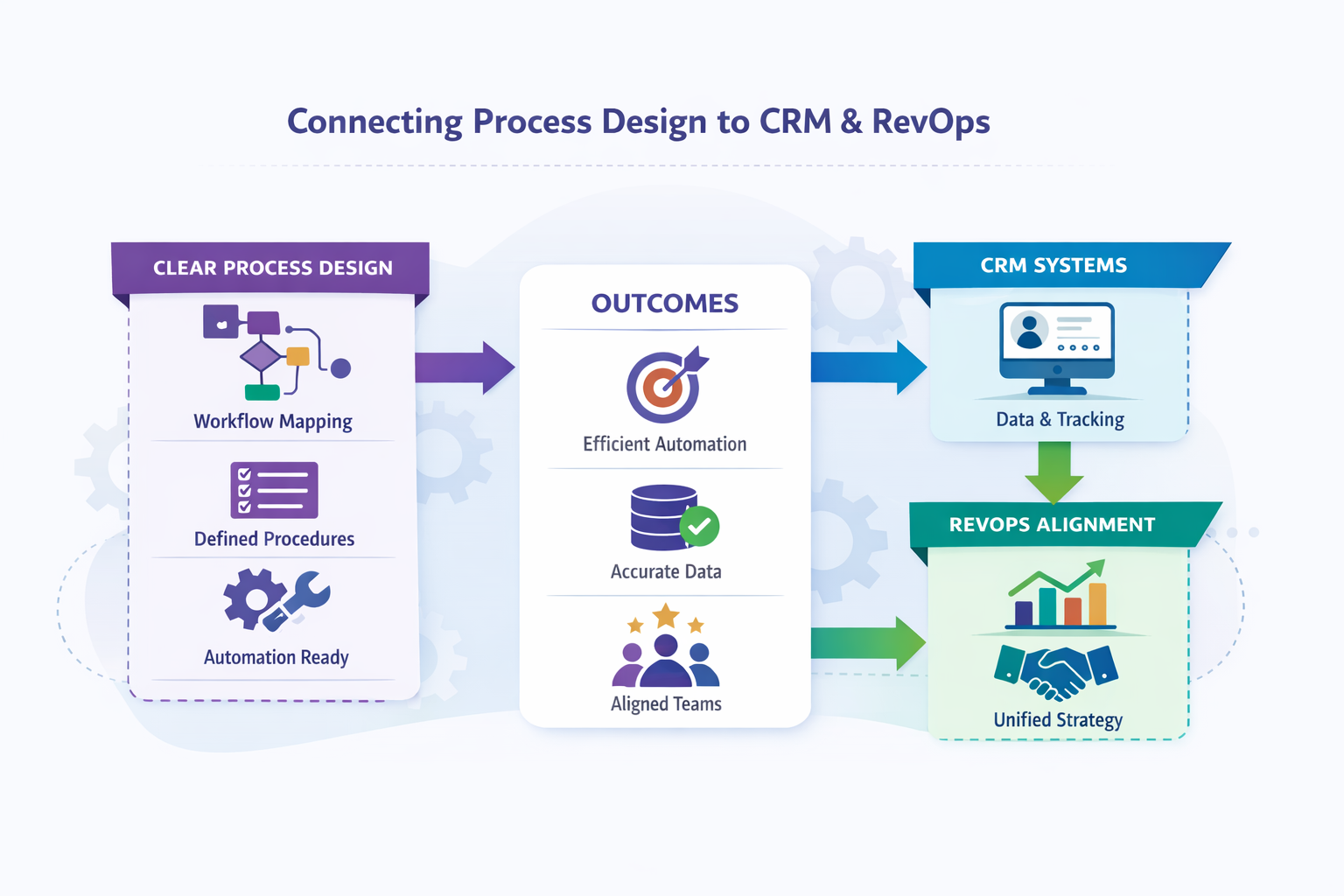
How process design connects to CRM and RevOps
Many organisations implement CRM systems hoping to fix operational problems. In reality, a CRM does not solve broken processes; it simply exposes them faster.
Before automation can work reliably, the underlying workflow must be clear and consistent. This is why process design is a foundation for successful CRM implementation and optimisation strategies that actually scale.
Process design also underpins revenue alignment. When marketing, sales, and operations run on disconnected workflows, revenue predictability suffers. A strong framework such as a full-funnel RevOps operating model ensures departments work from shared processes and definitions.
In many cases, the first step toward improvement is understanding where the system breaks. A structured diagnostic like this RevOps audit framework helps expose hidden operational gaps.
Signs your business needs process redesign
If any of the following sound familiar, your organisation likely has process design opportunities:
- Teams rely on manual workarounds to get things done
- Reporting numbers vary between departments
- Leadership meetings focus on resolving operational confusion
- Customer onboarding feels inconsistent
- Growth creates more complexity than efficiency
- Automation initiatives fail or create new problems
Often, these issues translate directly into revenue inefficiencies. A practical roadmap like this 90-day approach to fixing revenue leaks demonstrates how operational clarity drives measurable outcomes.
How Velocity approaches process optimisation
Velocity approaches business process design through a combination of operational analysis, systems thinking, and practical implementation. The focus is always on creating workflows that teams can actually use and maintain.
Our methodology includes:
- Cross-functional process discovery sessions
- Workflow mapping and documentation
- Technology alignment across systems
- Automation and optimisation opportunities
- Ongoing governance and improvement
For organisations looking to formalise this work, Velocity offers structured business process audit, design, and optimisation services that align operations with growth objectives.
Process design also connects strongly with customer strategy. As demonstrated in advanced customer segmentation strategies that improve efficiency, operational clarity enables better data usage and smarter decision-making.

Conclusion: Growth requires intentional process design
Technology alone cannot create efficiency. True scalability comes from intentionally designed processes that align people, data, and systems.
For mid-sized organisations across HigherEd, Government, Professional Services, SaaS, Retail, Travel, and beyond, Business Process Design and Analysis is often the hidden lever that unlocks sustainable growth.
When processes are clear, automation works better, reporting becomes trustworthy, and teams focus on delivering value instead of navigating operational confusion.
FAQs
1. What is business process design?
Business process design defines how work should flow across teams and systems to achieve consistent outcomes efficiently.
2. How is process analysis different from process design?
Process analysis examines how workflows currently operate, while process design focuses on creating improved workflows for scalability and efficiency.
3. Why do CRM projects fail without process design?
Because CRMs automate existing workflows. If those workflows are unclear or broken, automation amplifies the problems rather than solving them.
4. How long does a process optimisation project usually take?
It depends on scope, but many organisations begin seeing clarity and improvement within a few weeks of structured analysis and redesign.
5. Which industries benefit most from process design?
Any industry experiencing growth or complexity benefits, particularly HigherEd, Government, SaaS, Professional Services, Retail, and Hospitality sectors.