Organisations are seeking strategic interventions to accelerate revenue growth. Sales enablement is one such strategic function — a structured approach to equipping sales teams with the content, tools, and training they need to close deals more effectively. When executed correctly, it becomes a powerful revenue multiplier.
Velocity’s Sales Enablement & Direct Outreach service is designed to bridge the gap between marketing and sales, ensuring your commercial teams are fully empowered to convert high-quality leads into paying customers. In this article, we’ll explore how sales enablement directly contributes to revenue growth and why it should be a cornerstone of your business development strategy.

Covered in this article
What is Sales Enablement?
How Sales Enablement Increases Revenue
Direct Outreach: A Revenue Catalyst
How to Measure ROI on Sales Enablement
Is Your Organisation Ready?
Conclusion
FAQs

What is Sales Enablement?
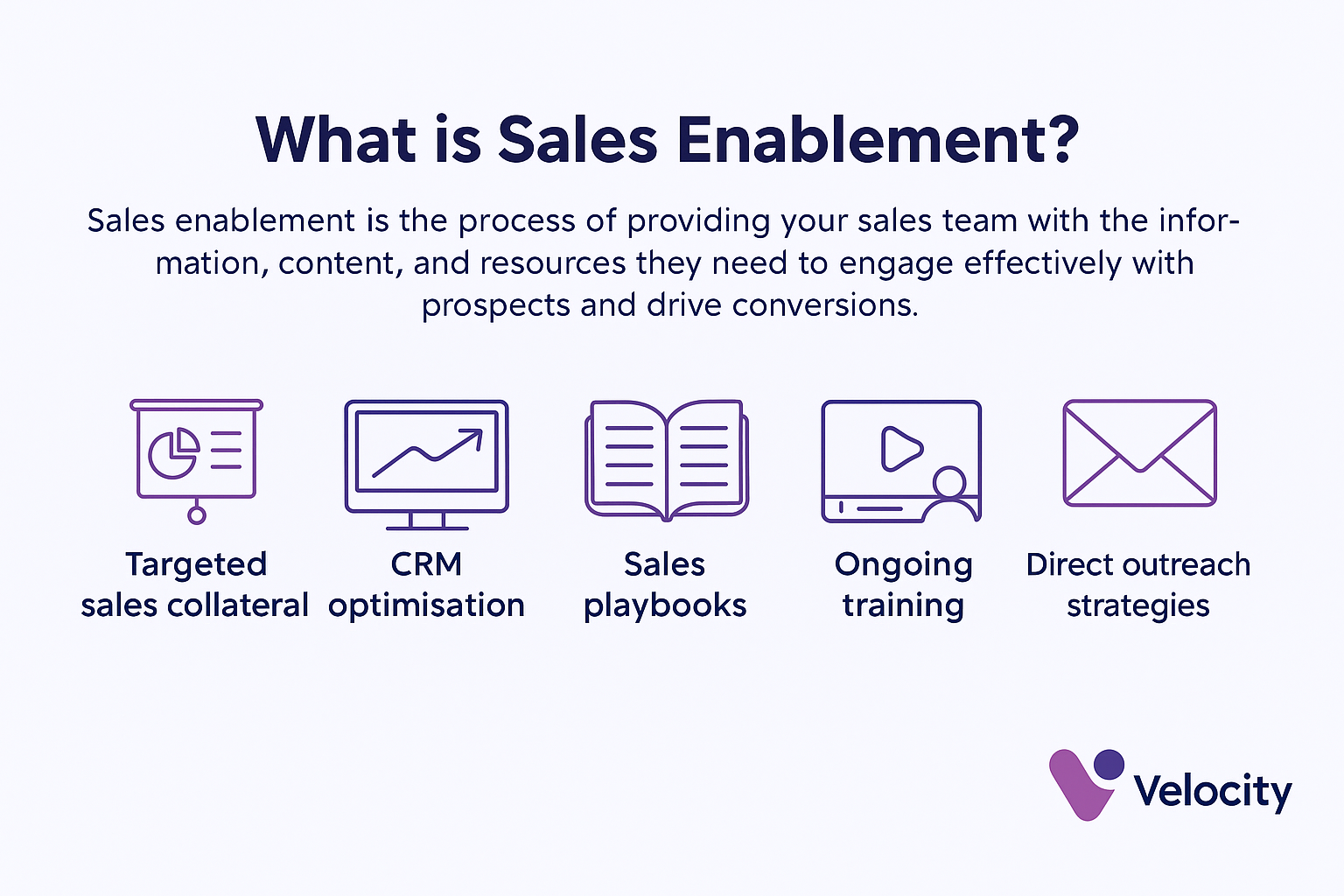
Sales enablement is the process of providing your sales team with the information, content, and resources they need to engage effectively with prospects and drive conversions. This includes:
-
Targeted sales collateral tailored to buyer personas and stages of the funnel
-
CRM optimisation to ensure accurate, actionable lead data
-
Sales playbooks aligned with buyer journeys
-
Ongoing training and performance feedback loops
-
Direct outreach strategies that are personalised and scalable
More than a one-time initiative, sales enablement is an ongoing collaboration between sales, marketing, and leadership that focuses on continuous improvement and measurable outcomes.
How Sales Enablement Increases Revenue
Sales enablement is more than a buzzword, it’s a strategic approach to driving measurable revenue growth. By empowering sales teams with the right tools, insights, and content, organisations can transform the way they engage with prospects and close deals.
The benefits go beyond improved efficiency; sales enablement creates a unified, data-informed commercial function that adapts to buyer behaviour and market shifts. Below, we explore how a robust enablement strategy translates directly into increased revenue.
1. Improved Lead Conversion Rates
Sales enablement ensures that leads nurtured through marketing are handed off with context, intent, and a clear engagement history. Sales professionals can then follow up with tailored messaging and content that resonates.
Key benefits:
-
Personalised outreach informed by behavioural data
-
Shortened sales cycles through strategic content deployment
-
Improved alignment between buyer needs and sales messaging
2. Higher Sales Productivity
By reducing the time salespeople spend searching for content, logging data, or manually qualifying leads, sales enablement frees up capacity for actual selling. With optimised workflows and better prospect intelligence, sales reps can prioritise the most promising opportunities.
Velocity’s services support this through:
-
Automated CRM workflows
-
Centralised asset libraries
-
AI-driven lead scoring and segmentation
3. Data-Driven Decision Making
Revenue teams must be agile, but agility without insight leads to waste. Sales enablement leverages analytics to monitor performance, identify gaps, and double down on what works.
With Velocity, you gain access to:
-
Real-time dashboards on sales pipeline health
-
Attribution models to track revenue impact
-
Continuous feedback loops to refine strategies
This allows leadership to course-correct in real time, eliminating blind spots and enabling a culture of accountability.
4. Better Alignment Between Sales and Marketing
Siloed departments cost companies both time and revenue. Sales enablement fosters strategic alignment between marketing and sales, ensuring that campaigns produce qualified leads and that sales follow up with consistent, compelling narratives.
What this looks like in practice:
-
Shared KPIs between sales and marketing
-
Campaign feedback loops
-
Unified messaging frameworks
Velocity plays a key role in facilitating this collaboration, ensuring each department reinforces the other’s efforts.
Direct Outreach: A Revenue Catalyst
Direct outreach remains one of the most powerful revenue levers available to sales teams. While inbound marketing builds awareness and nurtures demand, direct outreach accelerates conversations with high-value prospects who may not yet be actively engaging with your content.
When executed strategically, direct outreach shortens the path between identification and engagement. It allows sales teams to proactively target ideal customer profiles, tailor messaging to specific pain points, and create opportunities rather than waiting for them to surface.
Direct outreach is not cold emailing at scale. It is structured, data-informed engagement that combines:
- Clear ICP and target account definition
- Behavioural insights from CRM data
- Personalised messaging aligned to industry context
- Multi-touch sequences across channels
- Follow-up workflows driven by automation
Why Direct Outreach Drives Revenue
Direct outreach increases revenue because it:
- Expands pipeline faster by targeting high-intent or high-fit accounts
- Reduces dependency on inbound volume alone
- Shortens sales cycles through early value positioning
- Increases meeting-to-opportunity conversion rates
- Improves deal quality by focusing on strategic accounts
Instead of waiting for prospects to fill out forms or download content, outreach enables your team to start conversations with decision-makers earlier in their buying journey.
The Multiplier Effect of Structured Outreach
When direct outreach is embedded within a sales enablement framework, the impact compounds:
- CRM triggers notify reps when accounts show engagement signals
- Lead scoring prioritises accounts most likely to convert
- Automated task creation ensures immediate follow-up
- Playbooks standardise messaging while allowing personalisation
- Performance dashboards reveal which sequences generate pipeline
Without this structure, outreach becomes inconsistent and difficult to scale. With it, outreach becomes a predictable revenue engine.
Common Outreach Gaps That Limit Revenue
Even teams that “do outreach” often underperform because of operational blind spots:
- No clear segmentation between strategic and low-priority accounts
- Generic templates that lack contextual relevance
- No defined cadence or multi-touch strategy
- Inconsistent follow-up after initial contact
- No measurement of outreach-to-revenue conversion
These gaps reduce response rates and inflate cost per acquisition.
Direct Outreach Impact on Revenue Outcomes
| Outreach Practice | Revenue Outcome |
|---|---|
| Clearly defined Ideal Customer Profile | Higher quality pipeline and improved win rates |
| Personalised, role-specific messaging | Increased reply and meeting booking rates |
| Multi-channel cadence (email, LinkedIn, call) | Higher engagement and reduced drop-off |
| Automated follow-up task creation | Faster response time and improved close probability |
| CRM-based engagement tracking | Data-driven optimisation of sequences |
| Sales and marketing alignment on accounts | Increased conversion from meeting to opportunity |
| Sequence performance reporting | Better forecasting and scalable pipeline growth |
From Activity to Revenue
The key distinction is this: outreach activity does not equal revenue impact.
Revenue increases when outreach is:
- Focused on high-value accounts
- Supported by automation and CRM intelligence
- Aligned with marketing messaging and positioning
- Measured beyond open and reply rates
- Tied directly to pipeline and closed-won outcomes
Direct outreach, when strategically enabled, transforms sales from reactive to proactive. It creates controlled pipeline growth rather than unpredictable revenue swings.
In high-performing revenue organisations, direct outreach is not a side tactic. It is an engineered growth mechanism embedded within the broader sales enablement strategy.
How to Measure ROI on Sales Enablement
To ensure effectiveness, sales enablement initiatives must be measurable. Metrics to track include:
-
Lead-to-opportunity conversion rates
-
Sales cycle length
-
Win rates
-
Revenue per rep
-
Content usage and effectiveness
Velocity helps clients set benchmarks and implement systems to continuously track and improve performance, ensuring sales enablement is not just an initiative, but a growth engine.
Is Your Organisation Ready?
Sales enablement is not a plug-and-play solution — it must be tailored to your industry, audience, and sales model. Whether you’re navigating long buying cycles in higher education or high-volume lead generation in real estate, a well-executed enablement strategy will drive tangible results.
If your sales team lacks the tools, insights, or alignment to perform at peak levels, it may be time to reconsider your approach. Sales enablement could be the competitive edge you need to outperform the market.
Conclusion: Unlock Growth with Velocity
Sales enablement is not a cost centre — it’s a strategic investment in revenue acceleration. With the right frameworks and support, your sales team can close more deals, more efficiently. Velocity’s Sales Enablement & Direct Outreach service offers a turnkey solution to unify your revenue operations, empower your people, and deliver results.
Ready to transform your sales outcomes? Contact Velocity today to discuss how we can tailor a sales enablement strategy for your growth goals.

FAQs
1. What are common challenges businesses face without a sales enablement strategy?
Without a sales enablement strategy, businesses often experience misalignment between sales and marketing, inefficient processes, low content utilisation, and reduced visibility into what actually drives conversions. This can result in longer sales cycles and missed revenue opportunities.
2. How does sales enablement adapt to different industries or sectors?
Sales enablement must be customised to reflect sector-specific buyer journeys, regulatory environments, and decision-making processes. For example, higher education may require content tailored to academic stakeholders, while real estate demands agile CRM systems for rapid lead response.
3. What role does sales training play in enablement success?
Training ensures that sales teams can confidently use new tools, apply messaging frameworks, and adopt best practices. Ongoing training also helps teams stay updated on evolving buyer behaviour and tech advancements that influence sales techniques.
4. Can small businesses benefit from sales enablement or is it only for large enterprises?
Sales enablement is scalable. Small businesses often gain the most from implementing foundational strategies such as CRM integration, basic sales playbooks, and targeted outreach—enabling them to compete with larger firms on efficiency and precision.
5. How frequently should a sales enablement strategy be reviewed?
A quarterly review cycle is advisable to align with shifting market conditions, sales performance data, and feedback from sales reps. This allows for iterative improvements and ensures the strategy remains relevant and high-impact.