---
title: Why Your Quote-to-Cash System Keeps Breaking
description: Quote-to-cash systems are breaking under modern B2B demands. Here's why the architecture is the problem, and what RevOps leaders should demand instead.
image: https://velocity.digital/hubfs/Velocity%20Blog%20Featured%20Images%20(2).jpg
---
[](https://velocity.digital/)
- [Home](https://velocity.digital)
- Our Culture
- [Why choose Velocity?](https://velocity.digital/why-choose-velocity)
- [Our Team](https://velocity.digital/our-team)
- [Careers](https://velocity.digital/jobs)
- Services
- Revenue Growth Engine
- [Digital Campaign Strategy & Lead Generation](https://velocity.digital/digital-campaign-strategy-lead-generation)
- [RevOps & Revenue Funnel Alignment](https://velocity.digital/revops-revenue-funnel-alignmentand)
- [CRM Implementation & Onboarding](https://velocity.digital/crm-implementation-onboarding)
- AI & Automation Services
- [Process & Workflow Automation](https://velocity.digital/process-and-workflow-automation)
- [AI Readiness Assessment & Strategy](https://velocity.digital/ai-readiness-assessment-and-strategy)
- Localised Marketing
- [Smart City Portals](https://velocity.digital/city-sites-joburg-and-pretoria)
- Resources
- [SMB Onboarding Packages](https://velocity.digital/crm-implementation-optimisation#SMB_Packages)
- [Blog](https://velocity.digital/latest-news)
- [Video Hub](https://velocity.digital/video-hub)
- [Events](https://velocity.digital/events)
[CONTACT US](https://velocity.digital/contact)
# Why Your Quote-to-Cash System Keeps Breaking
- [Home](https://velocity.digital)
- [Blog](https://velocity.digital/latest-news)
Why Your Quote-to-Cash System Keeps Breaking
*Most quote-to-cash failures are not caused by bad tools or under-resourced teams. They are caused by a structural mismatch that has been quietly widening for years. Revenue complexity has outgrown the systems designed to manage it, and no amount of configuration, customisation, or additional headcount will fix that. This article explains why legacy QTC architecture breaks under modern B2B demands, and what revenue and operations leaders should be asking for instead.*
*.jpg?width=2000&height=1128&name=Velocity%20Blog%20Featured%20Images%20(2).jpg)*
## Covered in this article
[**The system is not failing. It is doing exactly what it was designed to do.**](https://velocity.digital/latest-news/why-your-quote-to-cash-system-keeps-breaking#one)
[**Storage versus flow: the architectural mismatch no one talks about**](https://velocity.digital/latest-news/why-your-quote-to-cash-system-keeps-breaking#two)
[**Why adding more functionality makes it worse**](https://velocity.digital/latest-news/why-your-quote-to-cash-system-keeps-breaking#three)
[**What modern revenue teams actually need from QTC**](https://velocity.digital/latest-news/why-your-quote-to-cash-system-keeps-breaking#four)
[**Where AI genuinely changes what is possible**](https://velocity.digital/latest-news/why-your-quote-to-cash-system-keeps-breaking#five)
[**What RevOps leaders should be demanding now**](https://velocity.digital/latest-news/why-your-quote-to-cash-system-keeps-breaking#six)
[**Conclusion**](https://velocity.digital/latest-news/why-your-quote-to-cash-system-keeps-breaking#seven)
[**FAQs**](https://velocity.digital/latest-news/why-your-quote-to-cash-system-keeps-breaking#eight)
## The system is not failing. It is doing exactly what it was designed to do.
There is a version of this conversation that happens in nearly every RevOps team at some point. Leadership asks for a pricing change, a new packaging tier, or a usage-based component to be layered into the current model. RevOps begins scoping the work, realises that what sounds like a straightforward update will require changes across CPQ logic, contract templates, billing rules, and revenue recognition, and delivers the news that it will take several weeks, not days.
Leadership is frustrated. RevOps feels misunderstood. And the same cycle repeats next quarter.
It is tempting to frame this as a communication problem, or a resourcing problem, or a sign that leadership does not understand system limitations. None of those interpretations are quite right. The real issue is architectural. Legacy quote-to-cash systems were not built for the pace or complexity of modern B2B revenue. They were built to record transactions and enforce rules in a world where pricing was relatively stable, deal structures were predictable, and exceptions were rare.
That world no longer exists. And the gap between how the business wants to operate and how the system can actually behave keeps widening.
Understanding why that gap exists, and what it would take to close it, starts with a distinction that does not get enough attention: the difference between systems built for storage and systems built for flow.
[](https://velocity.digital/hs/cta/wi/redirect?encryptedPayload=AVxigLIHfKRdTmTppMoGbYnz3Ag%2By7%2FmcGsl%2F7kn9%2FyNd7e9SXKbpbsrG6ZI0zuIramB3uCXSEVa36aAeiEAJC%2F2LCrwVw2E5CVJUXk1To4sp%2B799kSU7RC4GVzUaQlmKADmcIS6uXMB3Cqi%2FQSInae%2FidsDVvk7PeQ2P4L151bFzvupGlVJ&webInteractiveContentId=196658812810&portalId=6066958)
## Storage versus flow: the architectural mismatch no one talks about
Traditional revenue systems are optimised for storage. Their job is to capture what happened: a quote was created, a contract was signed, a deal moved stages. They are built around objects, fields, and tables that preserve history accurately and enforce defined rules against it. That is genuinely useful. But it is also fundamentally limited.
Modern B2B revenue teams do not primarily need to know what happened. They need to know what should happen next. Deals shift as buyers negotiate. Packaging evolves mid-quarter. Approvals get rerouted. Commercial exceptions become routine rather than rare. The work of revenue operations is not record-keeping. It is judgment, timing, trade-offs, and decision-making under conditions that change constantly.
That is what flow looks like. And storage-first systems were never built to support it.
The way most organisations have tried to bridge this gap is through retrofitting: adding rules, building workflows, writing custom code, and hiring people whose job is essentially to manually translate between how the business operates and what the system can model. That retrofit layer is where technical debt accumulates. It is where RevOps ends up spending the majority of its time managing risk rather than enabling growth. And it is why the department that should be architecting new go-to-market motions so often becomes the one that tells other teams no.
This is not a capability failure. It is a structural one. The system was built for a different era, and retrofitting it for the current one has a ceiling.
For a broader look at how operational clarity breaks down at scale, [**the CXO guide to operational clarity and scalable growth**](https://velocity.digital/latest-news/cxo-guide-to-operational-clarity-and-scalable-growth) is worth reading alongside this.
## Why adding more functionality makes it worse
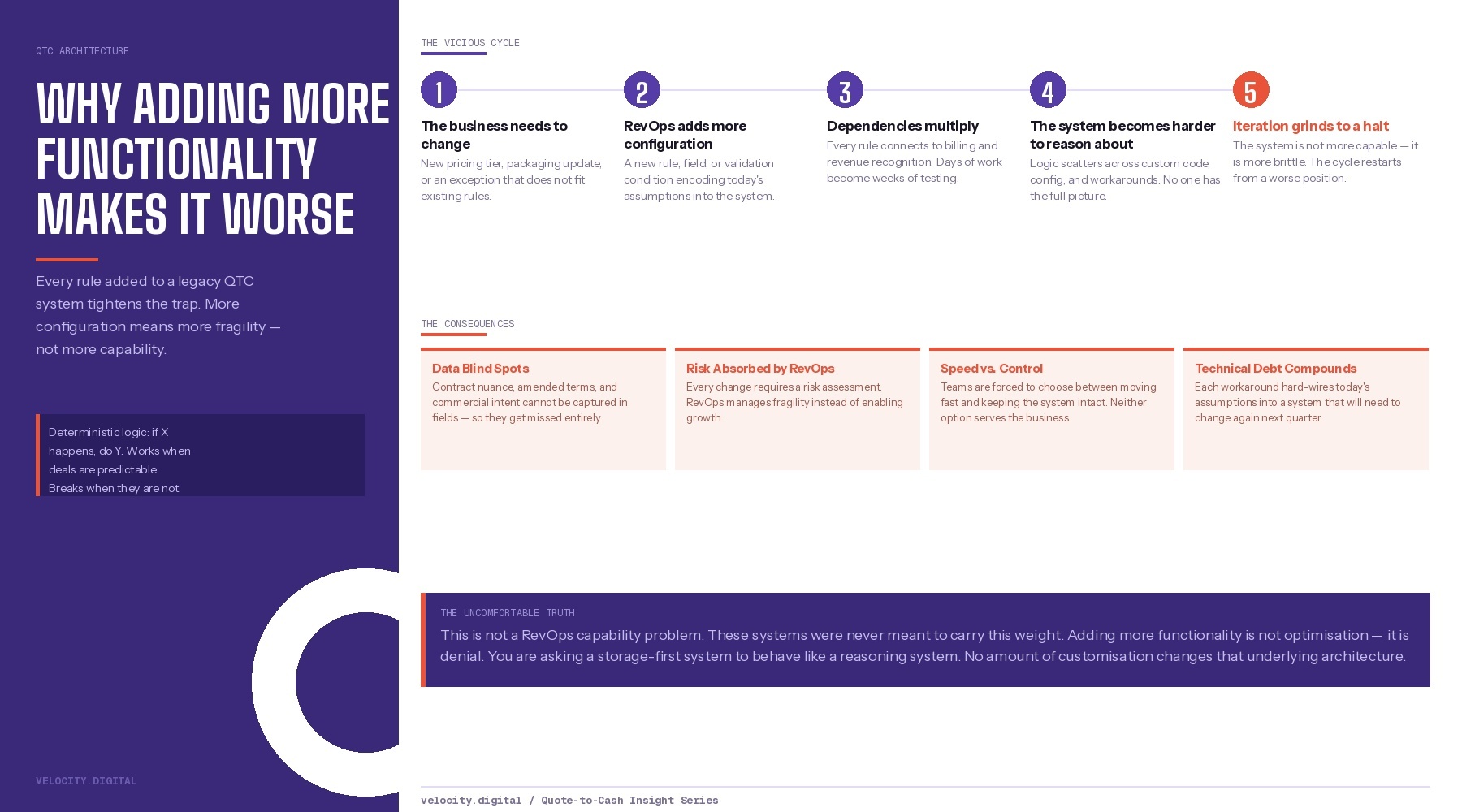
When a QTC system starts to crack under modern demands, the instinctive response is to add more. More rules. More fields. More validation logic. More workflows. On paper, each addition looks like a fix. In practice, each one makes the system harder to change.
Legacy QTC systems operate on deterministic logic: if X happens, do Y. That works cleanly when deals follow predictable paths. It breaks when pricing models change mid-quarter, when exceptions become routine, and when the business needs the system to exercise something closer to judgment rather than just execute a rule.
Every new scenario that gets encoded into configuration or custom code hard-wires today's assumptions into a system that will need to change again next month. And every new rule adds dependencies. A pricing adjustment that should take days now requires weeks of regression testing to ensure it does not break billing, revenue recognition, or downstream reporting. What starts as one additional condition becomes a fragile web that no one wants to touch.
Over time, the system does not become more capable. It becomes more brittle. Iteration slows not because the team lacks skill but because the architecture makes change genuinely dangerous.
There is also a ceiling to what configuration can solve. Traditional systems can only act on what they can explicitly see and model. They are not equipped to handle unstructured context: the amended contract terms buried in a PDF, the commercial concession agreed over email, the intent that lives in a call transcript. That context gets either flattened into fields or missed entirely, creating blind spots that require manual audits and workarounds to manage.
At a certain point, adding more functionality is not optimisation. It is denial. You are asking a storage-first system to behave like a reasoning system, and no amount of customisation changes that underlying reality.
## What modern revenue teams actually need from QTC
If you set aside what legacy systems can do and think instead about what modern B2B revenue actually demands, the requirements look quite different from what most QTC stacks were built to deliver.
Revenue teams need to be able to adapt pricing and packaging without triggering a re-architecture project. They need systems that can ingest and reason across unstructured context, not just structured fields. They need approval logic that applies judgment consistently across varying deal structures, not just enforces a binary rule. They need to handle edge cases without those edge cases becoming permanent technical debt. And they need to iterate safely, knowing that a change in one area will not silently break billing, reporting, or finance downstream.
The common thread across all of these is that change needs to be the default operating condition, not the exception the system struggles to accommodate. When flexibility feels dangerous, when pricing changes require risk assessments, when RevOps has to choose between speed and control on every decision, the system is failing the business even if it is technically functioning.
This connects directly to how revenue leakage happens in practice. When systems cannot adapt cleanly, teams compensate manually, and manual compensation introduces gaps. [**fixing revenue leaks within 90 days**](https://velocity.digital/latest-news/how-to-fix-revenue-leaks-in-90-days-a-practical-revops-roadmap) outlines a practical approach to identifying and closing those gaps once the structural picture is clear.
## Where AI genuinely changes what is possible
**Where AI genuinely changes what is possible**
For the first time in most operators' careers, AI introduces a genuine opportunity to close the gap between storage-first architecture and flow-first demands. But it is worth being precise about where that opportunity actually lies, because the hype around AI in revenue technology is running well ahead of the practical reality for most organisations.
AI does not fix a broken architecture by itself. If the underlying data is inconsistent, if business logic is fragmented across systems, and if no one has clearly defined how revenue decisions are supposed to work, AI copilots will stall, produce unreliable outputs, or simply generate more work. The foundation has to be there first.
Where AI genuinely adds capability is in three areas that legacy systems structurally cannot address:
- Reasoning across systems. Rather than seeing a discount in isolation, an AI layer can interpret how that discount interacts with contract terms, billing schedules, and downstream revenue recognition. It can surface conflicts before they become problems rather than after — turning what is currently a reactive fire drill into a proactive check.
- Applying judgment consistently at scale. When AI operates on a foundation of clean, governed data and clearly defined business logic, it can standardise the kind of contextual decision-making that currently lives in people's heads. Approval routing, deal structuring, exception handling — these become more consistent and less dependent on institutional knowledge that walks out the door when someone leaves.
- Adapting logic without brittle code. In a unified, no-code architecture, AI can help translate strategic intent into system updates, model the downstream financial impact of a proposed change, and validate it against existing rules before anything goes live. That changes the risk profile of iteration fundamentally — what used to require weeks of regression testing can be modelled and stress-tested in a fraction of the time.
The caveat, and it is an important one: AI cannot help with what has not been named. Before any of this becomes useful, leadership and operations teams need to be honest about where the current system is rigid, where it is blind, and where humans are currently bridging gaps that should not exist. That clarity is not a precondition for buying a tool. It is a precondition for knowing what problem you are actually trying to solve.
[**Transforming your finance function**](https://velocity.digital/latest-news/how-to-transform-your-finance-function) explores how the same tension between legacy architecture and modern operational demands plays out in adjacent teams.
## What RevOps leaders should be demanding now
The practical question for revenue and operations leaders is not whether to replace their QTC stack. For most organisations, that is a multi-year undertaking with significant change management implications. The more useful question is: what should you be holding the current system accountable for, and where should you be investing to close the gap in the interim?
A few principles are worth anchoring to.
First, stop treating RevOps velocity as a people problem. If your team is consistently slow to implement pricing changes or unable to model deal structures without significant manual effort, the bottleneck is almost certainly architectural rather than a reflection of capability. Diagnosing it correctly changes what the solution looks like.
Second, insist on unified business logic. One of the most common failure modes in QTC environments is having the rules for how revenue decisions work distributed across CPQ configuration, contract templates, billing rules, and the spreadsheets RevOps maintains on the side. Before AI can help, and before forecasting can be trusted, that logic needs to live in one place and be consistently applied.
Third, treat unstructured context as a first-class data problem. The commercial intent that lives in emails, call transcripts, and contract redlines is not peripheral information. It is often the most important signal in a deal, and systems that cannot capture and reason across it will always produce an incomplete picture.
Finally, use the audit before the roadmap. It is very common for organisations to invest in system improvements before they have a clear picture of where value is actually leaking and which operational fixes will produce the biggest return. [**what a RevOps audit actually examines before fixing revenue systems**](https://velocity.digital/latest-news/the-revops-audit-what-we-look-at-before-fixing-revenue-systems) is a useful reference for understanding what that diagnostic process should cover.
## Conclusion: stop defending the system and start questioning the architecture
The frustration most RevOps teams feel is real and earned. They are being asked to support a level of revenue complexity that the systems they manage were never designed for, and they are absorbing the blame when those systems cannot keep up.
The reframe that matters is this: the problem is not effort, and it is not tooling at the margin. It is architecture. Systems built for storage will always struggle under the demands of flow. And the answer is not more configuration. It is a clearer understanding of what modern revenue operations actually requires, honest diagnosis of where the current stack falls short, and deliberate investment in closing that gap rather than papering over it.
AI makes more of that possible than it ever has been. But only if the foundation is right. And getting the foundation right starts with being willing to name what is actually broken.
## FAQs
### 1. What is quote-to-cash and why does it matter for RevOps?
Quote-to-cash (QTC) refers to the end-to-end process from generating a sales quote through to contract execution, billing, and revenue recognition. It sits at the intersection of sales, finance, and operations, which means inefficiencies in QTC tend to create downstream problems across forecasting, reporting, and cash flow. For RevOps specifically, QTC is often where the most significant operational friction lives.
### 2. How do I know if our QTC system is the root cause of our RevOps problems?
Common indicators include: pricing or packaging changes that take weeks rather than days to implement, high volumes of manual workarounds maintained by RevOps, inconsistent deal structures across reps, billing errors tied to contract complexity, and forecasts that require significant manual adjustment to be trusted. If several of these are present simultaneously, the architecture is likely a contributing factor.
### 3. Is replacing a QTC platform the only way to fix these issues?
Not necessarily. Many organisations can make meaningful progress by improving the governance and logic layer that sits on top of existing systems, without a full platform replacement. The priority is ensuring that business logic is unified, data is consistent, and the humans bridging gaps manually are not the only thing holding the system together. A structured audit is usually the right starting point before committing to any platform decision.
### 4. What does AI-ready QTC actually mean in practice?
It means the underlying data and business logic are clean and consistent enough for AI to act on them reliably. This includes unified definitions of deal stages and approval rules, structured capture of contract terms, consistent CRM hygiene, and clear governance over how revenue decisions are made. Without that foundation, AI tools applied to QTC tend to surface noise rather than insight.
### 5. Where should RevOps leaders start if they want to improve QTC performance?
Start with diagnosis rather than investment. Map where manual effort is highest, where change requests stall, and where downstream systems — billing, revenue recognition, reporting — most frequently break when an upstream change is made. That mapping will reveal whether the issue is configuration, governance, or architecture, and will make the case for the right type of intervention far more clearly than a vendor evaluation process will.
## Subscribe
### Quick Lists
### Contact Us

**Head Office**
The Black Church, St. Mary's Place, Dublin, Ireland D07 P4AX
**South Africa**
25 Club Street, Linksfield, Johannesburg

[sales@velocitymedia.co.za](mailto:sales@velocitymedia.co.za)
-
-
-
-
### Services
- [Digital Campaign Strategy & Lead Generation](https://velocity.digital/digital-campaign-strategy-lead-generation)
- [Revenue Funnel Alignement](https://velocity.digital/revops-and-revenue-funnel-alignment)
- [CRM Implementation & Onboarding](https://velocity.digital/crm-implementation-onboarding)
- [AI Innovation & Automation](https://velocity.digital/process-and-workflow-automation)
- [Localised Marketing](https://velocity.digital/city-sites-joburg-and-pretoria)
### Useful Links
- [Contact Us](https://velocity.digital/contact)
- [Why choose velocity?](https://velocity.digital/why-choose-velocity)
- [Careers](https://velocity.digital/jobs)
- [Blog](https://velocity.digital/latest-news)
### Subscribe
Copyright © 2026. All Rights Reserved.
- [Privacy Policy](https://velocity.digital/privacy-policy)
- [Terms of use](https://velocity.digital/terms-of-use/)
- [PAIA Manual](https://velocity.digital/hubfs/Policy%20Documents/InfoReg_PAIA-Manual%20Velocity%20Media%20JAN%202024.pdf)

```json
{
"@context" : "https://schema.org",
"@type" : "BlogPosting",
"author" : {
"@type" : "Person",
"name" : "Shawn Greyling",
"url" : "https://velocity.digital/latest-news/author/shawn-greyling"
},
"dateModified" : "2026-02-27T07:48:14.759Z",
"datePublished" : "2026-02-27T07:48:14.000Z",
"headline" : "Why Your Quote-to-Cash System Keeps Breaking",
"image" : [ "https://velocity.digital/hubfs/Velocity%20Blog%20Featured%20Images%20(2).jpg" ],
"mainEntityOfPage" : {
"@id" : "https://velocity.digital/latest-news/why-your-quote-to-cash-system-keeps-breaking",
"@type" : "WebPage"
},
"publisher" : {
"@type" : "Organization",
"logo" : {
"@type" : "ImageObject",
"url" : "https://velocity.digital/hubfs/Untitled%20design-Apr-05-2024-07-12-12-3806-AM.png"
},
"name" : "Global Trolley (Pty) Ltd T/A Velocity Media"
}
}
```