
Buzzwords in business. They are all around us. But what do they really mean? Are buzzwords simply another innovation that appears with business trends just to fall out of use again when replaced by something more “innovative”? What have been the most popular buzzwords over the last 3 decades? Are there any that have stuck around? Let’s explore.
-Dec-08-2025-10-14-58-2567-AM.png?width=2000&height=1127&name=Velocity%20Blog%20Featured%20Images%20(3)-Dec-08-2025-10-14-58-2567-AM.png)
Covered in this article
Buzzwords - Help or Hindrance?
No Buzzing Around When it Comes to Innovation
The Importance of Innovation
Crossing the Dividing Line
FAQs
Buzzwords - Help or Hindrance?
Buzzwords - words or expressions from a particular subject matter that have become fashionable through regular use. Some can be quite helpful, others are used so frequently they tend to lose their impact.
Buzzwords in business create a common language - they can be used to quickly convey ideas or initiatives that should be prioritised (think “pain points” or “low-hanging fruit”). They can signal that your business is aligned with market trends (think “agile” or “AI-driven”) or be used to unlock deeper strategic conversations with your target clients. For example, “We want to reduce the time our reps spend on routine admin tasks” can open the door to talk about CRMs, automation and workflows, and the opportunity to increase the quality of your client service.
From a marketing perspective, buzzwords are often powerful hooks to attract your target audience. Job seekers use buzzwords to make their profiles more discoverable - think “trusted advisor”, “change agent”, “thought leader”, to mention but a few.
Overuse or vague terms can erode trust. Reading 10 proposals that all mention typical trending words like “synergy” or “forward-thinking” can quickly cause clients to experience buzzword fatigue. Saying “We need to innovate” does not really address the root cause of operational problems like workflow bottlenecks or outdated standard operating procedures.
Buzzwords can also cause misalignment or misunderstanding between stakeholders. Not everyone has the same understanding of “digital transformation” - the Marketing Director may think of a new CRM system, while the IT Department may think of cloud migration. All of this can cause teams to resist change, especially where past projects failed to deliver on their expectations.

No Buzzing Around When it Comes to Innovation
“Innovation distinguishes between a leader and a follower.” Many entrepreneurs will agree - this is one of those Steve Jobs quotes that every business owner needs to hear. But is “innovation” just another buzzword? Well, borrowed from Latin, with the earliest known use in the 1500s, its use certainly seems to have been solidified in the English language. The fact that there is a Global Innovation Index (GII) further underscores the importance of the word. The GII uses technological progress, adoption rates, investment patterns and socio-economic impacts to track innovation trends across the world.
Using approximately 80 indicators, grouped according to innovation inputs and outputs, the index measures the extent of innovation inputs amongst economy profiles, like Institutions, Human Capital and Research, Infrastructure, Market and Business Sophistication. Innovation outputs are measured in terms of Knowledge and Technology outputs and Creative outputs. Other metrics used include:
- The income group to which the economy profile belongs
- Geographical region
- Population in millions
- GDP in billions of USD purchasing power parity (PPP), and
- GDP per capita in USD PPP.
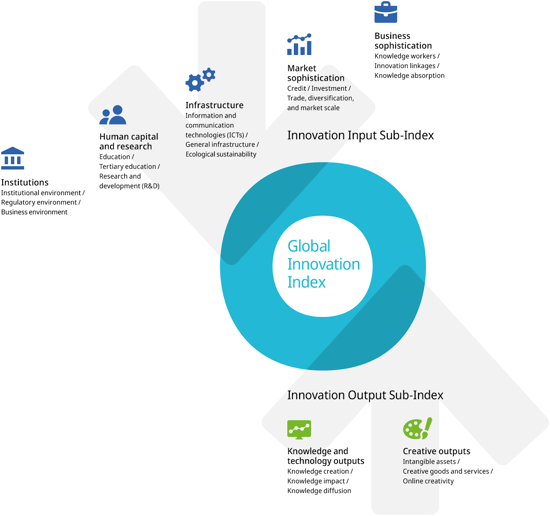
Source: Framework of the Global Innovation Index 2025
Although changes in methodology and variations in data availability may affect year-to-year comparisons of the index rankings, Switzerland, Sweden and the United States have retained their positions amongst the top three innovators for the last five years.
While Switzerland still leads the pack overall, Singapore is ranked first in terms of innovation within Institutions. The Republic of Korea is the leader when it comes to innovation within Human Capital and Research, while Norway surged into the top 20 innovative countries, leading the Infrastructure innovation pillar. The US leads the way when it comes to innovation in the Market and Business Sophistication pillars, while China is ahead of the pack when it comes to Knowledge and Technology outputs. Switzerland remains the global leader in the Creative outputs pillar. South Africa leads innovation in Sub-Saharan Africa but scores only 61st place out of 139 countries in the overall index.
The Importance of Innovation
Whether you are speaking to global leaders of well-established companies or emerging entrepreneurs in the SME space, one common factor stands out: Innovation.
In a constantly changing ecosystem, innovation is critical because:
- It allows for embracing change, being adaptable and responsive to any challenges the market may pass your way - just think of how the world had to adapt during Covid-19; those who did not adapt their businesses faced challenges on a monumental scale, often experiencing huge losses and/or closing down completely.
- It fosters economic growth in increasingly difficult economic circumstances.
- It distinguishes businesses from their competitors. Like the legendary Coco Chanel said, “In order to be irreplaceable, one must always be different.”
The refusal to accept “this is how it’s always been done” is what makes the difference. Innovation separates those who embrace growth and change from those who would rather risk obsolescence than make a change. Innovation is the dividing line - the business imperative if you want to leave your mark in the world.
Crossing the Dividing Line
In this series of articles, we will explore why buzzwords emerge, what they reveal and what they conceal, discuss why innovation is more than a buzzword, but involves actions and outcomes, and highlight the connection between innovation, purpose, ethics and technology. Finally, we will help you assess which side you are on with a guide to process-driven innovation.

FAQs
1. What exactly is a business buzzword?
A business buzzword is a term or phrase that gains popularity through frequent use in corporate environments. While buzzwords can create a shared language and quickly communicate complex ideas, they often lose impact when overused or poorly defined.
2. Why do buzzwords become a problem in organisations?
Buzzwords become problematic when they oversimplify issues, create misalignment between departments, or give the illusion of progress without substantive action. When terms like “digital transformation” or “innovation” mean different things to different teams, execution suffers.
3. How is innovation different from a buzzword?
Unlike many buzzwords, innovation requires measurable action, investment and accountability. It is not simply a label or intention. True innovation drives transformation, competitive advantage and resilience in changing market conditions.
4. What does the Global Innovation Index measure?
The Global Innovation Index evaluates countries using around 80 indicators across areas such as human capital, institutions, infrastructure, technology outputs and economic sophistication. It provides a comparative view of how effectively nations drive and sustain innovation.
5. Why is innovation essential for modern businesses?
Innovation enables organisations to stay adaptable, identify opportunities, respond to disruption and differentiate themselves from competitors. Without continuous improvement, companies risk stagnation and vulnerability in volatile markets.
6. How can businesses avoid falling into “buzzword thinking”?
Businesses should define terms clearly, connect them to specific objectives, and focus on measurable outcomes. Replacing vague statements with process-driven innovation frameworks ensures alignment, accountability and real progress.
7. What does it mean to “cross the dividing line” in innovation?
Crossing the dividing line means moving from talking about innovation to embedding it into strategy, operations and culture. It reflects a commitment to experimentation, continuous improvement and using innovation as a core driver of business success.
8. How can organisations get started with meaningful innovation?
Start by identifying operational bottlenecks, outdated processes or areas where customer value can be improved. Align leadership, set clear objectives and introduce structured innovation frameworks that encourage action rather than rhetoric.