---
title: Winning in a New Era of Revenue Complexity
description: Revenue is more complex than ever. Learn how modern teams turn data, alignment, and RevOps into predictable, scalable growth.
image: https://velocity.digital/hubfs/Velocity%20Blog%20Featured%20Images%20(7)-Feb-18-2026-01-21-20-6049-PM.png
---
[](https://velocity.digital/)
- [Home](https://velocity.digital)
- Our Culture
- [Why choose Velocity?](https://velocity.digital/why-choose-velocity)
- [Our Team](https://velocity.digital/our-team)
- [Careers](https://velocity.digital/jobs)
- Services
- Revenue Growth Engine
- [Digital Campaign Strategy & Lead Generation](https://velocity.digital/digital-campaign-strategy-lead-generation)
- [RevOps & Revenue Funnel Alignment](https://velocity.digital/revops-revenue-funnel-alignmentand)
- [CRM Implementation & Onboarding](https://velocity.digital/crm-implementation-onboarding)
- AI & Automation Services
- [Process & Workflow Automation](https://velocity.digital/process-and-workflow-automation)
- [AI Readiness Assessment & Strategy](https://velocity.digital/ai-readiness-assessment-and-strategy)
- Localised Marketing
- [Smart City Portals](https://velocity.digital/city-sites-joburg-and-pretoria)
- Resources
- [SMB Onboarding Packages](https://velocity.digital/crm-implementation-optimisation#SMB_Packages)
- [Blog](https://velocity.digital/latest-news)
- [Video Hub](https://velocity.digital/video-hub)
- [Events](https://velocity.digital/events)
[CONTACT US](https://velocity.digital/contact)
# Winning in a New Era of Revenue Complexity
- [Home](https://velocity.digital)
- [Blog](https://velocity.digital/latest-news)
Winning in a New Era of Revenue Complexity
*Revenue has become more complex, not because teams are underperforming, but because buyers have changed. Deals are influenced by more channels, more stakeholders, and longer decision cycles. In this environment, traditional sales and marketing structures struggle to keep pace, and revenue becomes harder to predict, measure, and scale.*
*The organisations that win are not the ones doing more activity. They are the ones building a modern revenue operating model: clean data, aligned teams, consistent definitions, and systems that turn complexity into clarity. This article explores what has changed, where teams break down, and how to build for sustainable growth.*
-Feb-18-2026-01-21-20-6049-PM.png?width=2000&height=1128&name=Velocity%20Blog%20Featured%20Images%20(7)-Feb-18-2026-01-21-20-6049-PM.png)
## Covered in this article
[What changed in modern buying](https://velocity.digital/latest-news/winning-in-a-new-era-of-revenue-complexity#one)
[Why revenue complexity breaks teams](https://velocity.digital/latest-news/winning-in-a-new-era-of-revenue-complexity#two)
[The new failure points to watch](https://velocity.digital/latest-news/winning-in-a-new-era-of-revenue-complexity#three)
[How high-performing teams turn complexity into clarity](https://velocity.digital/latest-news/winning-in-a-new-era-of-revenue-complexity#four)
[Practical steps you can take this quarter](https://velocity.digital/latest-news/winning-in-a-new-era-of-revenue-complexity#five)
[Conclusion](https://velocity.digital/latest-news/winning-in-a-new-era-of-revenue-complexity#six)
[FAQs](https://velocity.digital/latest-news/winning-in-a-new-era-of-revenue-complexity#seven)
[](https://velocity.digital/hs/cta/wi/redirect?encryptedPayload=AVxigLKANPwK%2FhVOwyttPRWZAGooy%2FYv5cnM%2FkwJ3ZZ4lbuLgXf3Yr%2BcPnHU1PSBC1j1K7qhCuIfGh3gpzmAXLzP1rxGNNaTftQnhfwyklViEtf%2BnWoo0vs%2BSdWfbJpZUthvtLh4526heHbSU5X7FRUxfPAx6I6i4SfwSFH%2F%2Faeay3w6wOQW&webInteractiveContentId=196658812810&portalId=6066958)
## What changed in modern buying
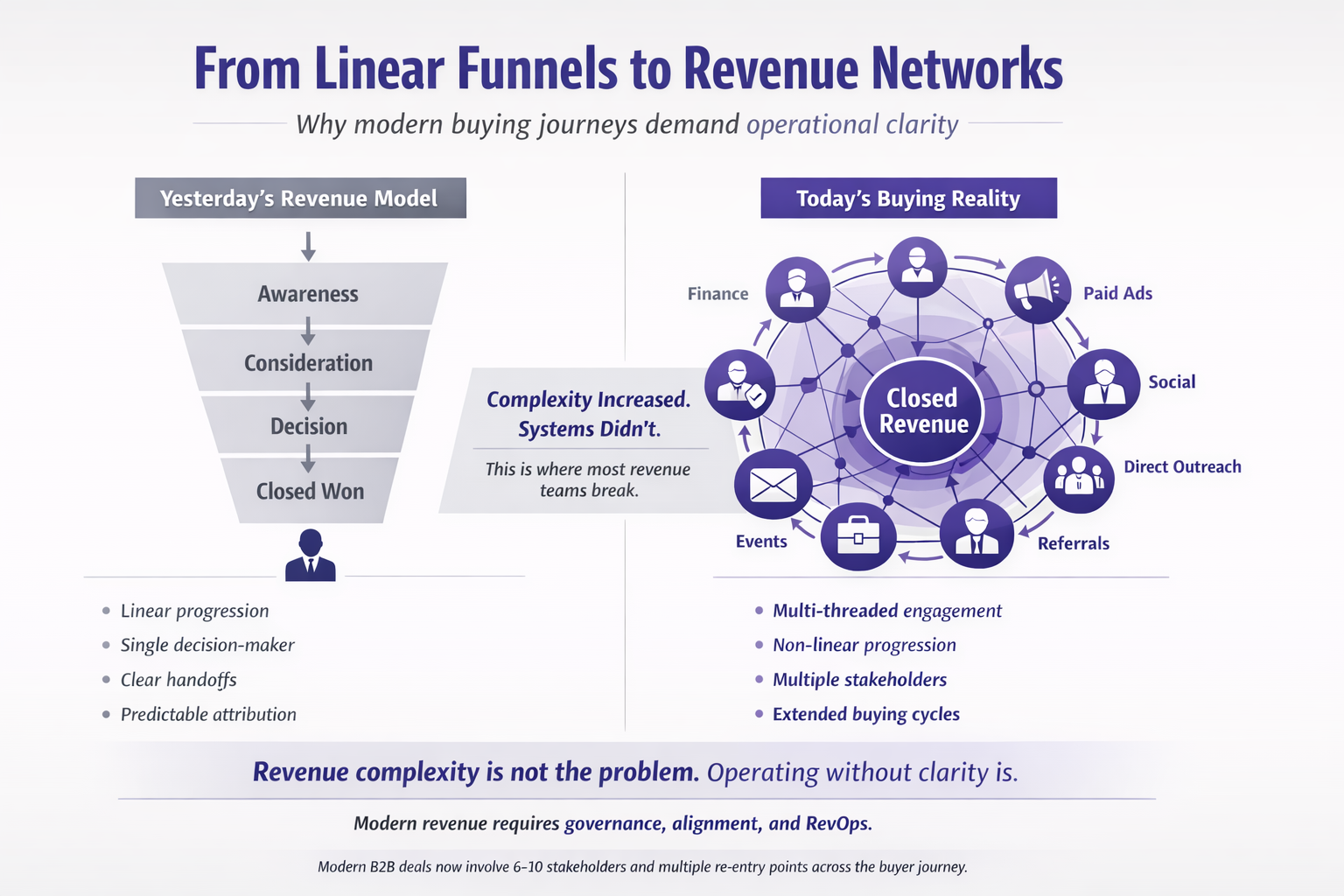
Revenue complexity is not a trend. It is a structural shift driven by how buyers research, evaluate, and decide. Many teams are still operating with assumptions that were true a decade ago: linear funnels, clear handoffs, and simple attribution.
Today, revenue is influenced by a blend of signals across channels, timeframes, and stakeholders. Buyers consume content, compare vendors, consult peers, and re-enter the funnel multiple times before engaging a salesperson.
**Modern buying has three defining characteristics:**
- **More stakeholders:** buying committees, not single decision-makers
- **More touchpoints:** multiple channels influence the same deal
- **More time:** longer cycles with pauses, restarts, and internal reviews
These changes are not a problem. They are the new reality. The opportunity is to build revenue systems that reflect this reality rather than fighting it.
## Why revenue complexity breaks teams
Teams break when complexity increases but the operating model stays the same. In most organisations, revenue functions were built for speed and volume, not orchestration and measurement.
As complexity rises, three things typically happen:
- Teams lose visibility into what is actually driving pipeline and closed-won revenue
- Operational effort increases as people compensate with manual reporting and ad hoc fixes
- Leaders make decisions with less confidence because numbers are disputed or inconsistent
This is where measurement becomes dangerous. When the underlying system is fragmented, dashboards become a story, not a source of truth.
A common example is attribution. If your attribution window is poorly defined, it can distort how teams interpret ROI and allocate spend. That is why addressing attribution logic matters as much as creative execution. If you want to understand this more deeply, read [why attribution windows quietly distort revenue performance](https://velocity.digital/latest-news/attribution-window-in-marketing-why-its-distorting-your-revenue-data).
## The new failure points to watch
Revenue complexity introduces new failure points that are often invisible until results flatten. These are not isolated issues. They compound across the funnel.
### 1. Data becomes fragmented across tools and teams
When marketing, sales, and customer success use different systems and definitions, revenue becomes impossible to measure consistently. One team optimises for leads, another for pipeline, and another for retention, without shared logic tying them together.
Many organisations attempt to solve this by adding more tools. The better approach is to evaluate tool usage, overlap, and data flow. A structured audit is often the turning point. Use [this marketing operations tech stack audit checklist](https://velocity.digital/latest-news/marketing-operations-tech-stack-audit-checklist) to identify gaps, redundancies, and measurement risk.
### 2. Personalisation scales, but consistency breaks
Prospects expect relevance. AI and automation make it easier to personalise at scale, but they also increase the risk of inconsistent messaging, weak segmentation, and misaligned follow-ups.
Strong personalisation is not just about dynamic tokens. It requires shared context: lifecycle stage logic, role-based positioning, and consistent handoffs between marketing and sales. If you want a stronger framework, explore [how to elevate sales personalisation beyond basic name inserts](https://velocity.digital/latest-news/elevating-sales-personalisation-beyond-basic-name-inserts).
### 3. Forecasting becomes unstable without governance
When deal stages mean different things to different reps, or CRM hygiene is inconsistent, forecasting becomes opinion-driven. Pipeline may look healthy, but leadership confidence declines as revenue swings.
Predictability improves when operational standards are enforced. For a deeper breakdown of why forecasts fail and how to fix them, read [this guide to fixing revenue forecasting at the source](https://velocity.digital/latest-news/from-pipeline-to-predictability-how-revenue-forecasting-breaks).
### 4. Accountability becomes unclear across the funnel
As revenue journeys become non-linear, the question “Who owns this?” becomes harder to answer. Leads may be influenced by marketing, progressed by sales, and saved by customer success. Without shared KPIs and clear handoffs, performance becomes subjective.
This is the point where revenue operations becomes essential, not optional. RevOps provides the shared system that aligns teams on definitions, workflows, and performance truth. If you want a full-funnel view, explore [Velocity’s full-funnel RevOps strategy approach](https://velocity.digital/rev-ops-a-full-funnel-strategy).
## How high-performing teams turn complexity into clarity
The best revenue teams do not reduce complexity by oversimplifying. They manage complexity by engineering clarity. That clarity comes from operational design.
**High-performing organisations tend to do five things consistently:**
- **Standardise definitions:** lifecycle stages, deal stages, and qualification criteria
- **Build shared governance:** one set of rules across marketing, sales, and success
- **Design measurement intentionally:** attribution, influence, and forecasting aligned to reality
- **Automate the basics:** task creation, follow-ups, alerts, and data validation
- **Create closed-loop feedback:** learn from outcomes, refine systems, repeat
What makes these organisations different is not effort. It is architecture. They treat revenue like an operating system, not a set of disconnected tactics.
### A simple mindset shift
Instead of asking, “How do we generate more activity?”, high-performing teams ask:
- Where does revenue stall and why?
- Which signals predict conversion, not just engagement?
- What must be true in the CRM for reporting to be trusted?
- What should happen automatically when a buyer takes action?
These questions turn complexity into structured improvement.
## Practical steps you can take this quarter
If revenue feels harder to manage than it used to, you do not need a total rebuild. You need to stabilise the fundamentals. These steps create a measurable shift in clarity and performance within a quarter.
- **Map your revenue journey:** document how a prospect becomes a customer, including loops and delays
- **Audit your definitions:** align lifecycle stages, MQL criteria, and deal stages across teams
- **Fix your reporting inputs:** require close dates, next steps, and stage criteria in the CRM
- **Identify tool overlap:** remove redundant platforms and fix data flow between essential systems
- **Agree on shared KPIs:** pipeline quality, conversion rates, cycle length, retention, and expansion
Most importantly, assign ownership. Revenue clarity is rarely a technology issue. It is a governance issue.
[](https://cta-redirect.hubspot.com/cta/redirect/6066958/7fa31ec4-2c12-4254-bc58-78d89b780ce8)
## Conclusion: Complexity is a competitive advantage when managed well
Revenue complexity is rising for everyone. The difference is how organisations respond. Some add tools, push for more activity, and accept unpredictability as normal. Others build a modern revenue operating model and use complexity as leverage.
When your teams share definitions, your systems enforce good data, and your reporting reflects reality, complexity becomes a source of advantage. You can identify what drives revenue faster, act earlier when deals are at risk, and scale without losing control.
Winning in this era is not about doing more. It is about building better.
## FAQs
### 1. What does “revenue complexity” actually mean?
Revenue complexity refers to the increase in channels, stakeholders, touchpoints, and timeframes that influence revenue outcomes. Deals are no longer driven by a single campaign or a linear buyer journey, which makes measurement and forecasting harder without strong operational structure.
### 2. Why do teams struggle as buying journeys become less linear?
Most teams are designed around handoffs and isolated KPIs. When buyers loop, pause, and re-enter, those handoffs create gaps in ownership, data, and follow-up. Without shared governance, performance becomes inconsistent.
### 3. Is the solution to buy more tools or adopt AI?
Tools and AI help, but they do not solve governance. If definitions, data quality, and workflows are inconsistent, more tools usually increase complexity. Start by auditing usage, fixing data flow, and aligning processes.
### 4. How can we improve predictability without slowing the sales team down?
Use automation to enforce data hygiene and reduce manual admin. Standardise stage criteria, require minimal critical fields at key moments, and trigger tasks and alerts automatically based on buyer actions and deal ageing.
### 5. What is the first place to start if our revenue reporting is not trusted?
Start with definitions and inputs. Align lifecycle stages, deal stages, and qualification criteria across teams, then ensure the CRM captures close dates, next steps, and stage criteria consistently. Trust in reporting comes from consistent operational logic.
## Subscribe
### Quick Lists
### Contact Us

**Head Office**
The Black Church, St. Mary's Place, Dublin, Ireland D07 P4AX
**South Africa**
25 Club Street, Linksfield, Johannesburg

[sales@velocitymedia.co.za](mailto:sales@velocitymedia.co.za)
-
-
-
-
### Services
- [Digital Campaign Strategy & Lead Generation](https://velocity.digital/digital-campaign-strategy-lead-generation)
- [Revenue Funnel Alignement](https://velocity.digital/revops-and-revenue-funnel-alignment)
- [CRM Implementation & Onboarding](https://velocity.digital/crm-implementation-onboarding)
- [AI Innovation & Automation](https://velocity.digital/process-and-workflow-automation)
- [Localised Marketing](https://velocity.digital/city-sites-joburg-and-pretoria)
### Useful Links
- [Contact Us](https://velocity.digital/contact)
- [Why choose velocity?](https://velocity.digital/why-choose-velocity)
- [Careers](https://velocity.digital/jobs)
- [Blog](https://velocity.digital/latest-news)
### Subscribe
Copyright © 2026. All Rights Reserved.
- [Privacy Policy](https://velocity.digital/privacy-policy)
- [Terms of use](https://velocity.digital/terms-of-use/)
- [PAIA Manual](https://velocity.digital/hubfs/Policy%20Documents/InfoReg_PAIA-Manual%20Velocity%20Media%20JAN%202024.pdf)

```json
{
"@context" : "https://schema.org",
"@type" : "BlogPosting",
"author" : {
"@type" : "Person",
"name" : "Shawn Greyling",
"url" : "https://velocity.digital/latest-news/author/shawn-greyling"
},
"dateModified" : "2026-02-18T13:34:01.336Z",
"datePublished" : "2026-02-18T13:34:01.000Z",
"headline" : "Winning in a New Era of Revenue Complexity",
"image" : [ "https://velocity.digital/hubfs/Velocity%20Blog%20Featured%20Images%20(7)-Feb-18-2026-01-21-20-6049-PM.png" ],
"mainEntityOfPage" : {
"@id" : "https://velocity.digital/latest-news/winning-in-a-new-era-of-revenue-complexity",
"@type" : "WebPage"
},
"publisher" : {
"@type" : "Organization",
"logo" : {
"@type" : "ImageObject",
"url" : "https://velocity.digital/hubfs/Untitled%20design-Apr-05-2024-07-12-12-3806-AM.png"
},
"name" : "Global Trolley (Pty) Ltd T/A Velocity Media"
}
}
```