---
title: "AI Travel Discovery: Stay Visible in Joburg & Pretoria"
description: "SME tourism operators in Joburg and Pretoria: learn how AI travel discovery reshapes search and what to do to stay visible."
image: https://velocity.digital/hubfs/AI%20%26%20Travel%20Discovery%20Staying%20visible%20in%20an%20AI-driven%20journey.png
---
[](https://velocity.digital/)
- [Home](https://velocity.digital)
- Our Culture
- [Why choose Velocity?](https://velocity.digital/why-choose-velocity)
- [Our Team](https://velocity.digital/our-team)
- [Careers](https://velocity.digital/jobs)
- Services
- Revenue Growth Engine
- [Digital Campaign Strategy & Lead Generation](https://velocity.digital/digital-campaign-strategy-lead-generation)
- [RevOps & Revenue Funnel Alignment](https://velocity.digital/revops-revenue-funnel-alignmentand)
- [CRM Implementation & Onboarding](https://velocity.digital/crm-implementation-onboarding)
- AI & Automation Services
- [Process & Workflow Automation](https://velocity.digital/process-and-workflow-automation)
- [AI Readiness Assessment & Strategy](https://velocity.digital/ai-readiness-assessment-and-strategy)
- Localised Marketing
- [Smart City Portals](https://velocity.digital/city-sites-joburg-and-pretoria)
- Resources
- [SMB Onboarding Packages](https://velocity.digital/crm-implementation-optimisation#SMB_Packages)
- [Blog](https://velocity.digital/latest-news)
- [Video Hub](https://velocity.digital/video-hub)
- [Events](https://velocity.digital/events)
[CONTACT US](https://velocity.digital/contact)
# AI & Travel Discovery: Staying visible in an AI-driven journey
- [Home](https://velocity.digital)
- [Blog](https://velocity.digital/latest-news)
AI & Travel Discovery: Staying visible in an AI-driven journey
*Your potential guests have stopped opening Google first. They are asking ChatGPT, Google Gemini, or Perplexity AI where to go this weekend, and the AI answers before they ever reach your website. For SME tourism operators in Johannesburg and Pretoria, that shift is already costing bookings.*
*This article explains how AI travel discovery is reshaping destination research, what practical steps tourism marketers in Gauteng can take right now to stay visible, and which KPIs tell you whether your efforts are working.*
## Covered in this article
[Why AI Travel Discovery Is Reshaping How South African Tourists Find Destinations](https://velocity.digital/latest-news/ai-travel-discovery-staying-visible-johannesburg-pretoria#section1)
[Practical Steps for Joburg and Pretoria Tourism Operators](https://velocity.digital/latest-news/ai-travel-discovery-staying-visible-johannesburg-pretoria#section2)
[KPIs to Measure Your AI Travel Visibility](https://velocity.digital/latest-news/ai-travel-discovery-staying-visible-johannesburg-pretoria#section3)
[FAQs](https://velocity.digital/latest-news/ai-travel-discovery-staying-visible-johannesburg-pretoria#faqs)
## Why AI Travel Discovery Is Reshaping How South African Tourists Find Destinations
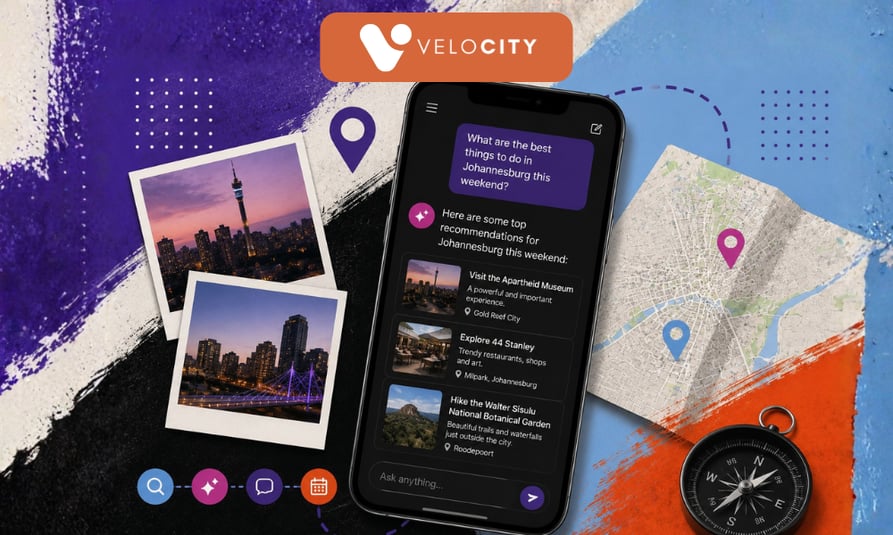
Your potential guests are no longer starting their trip research on Google. They are opening ChatGPT, Google Gemini, or Perplexity AI and asking: "What are the best things to do in Johannesburg this weekend?" The AI answers. It recommends specific experiences, neighbourhoods, and operators. And in many cases, the traveller never clicks through to a traditional search results page at all.
This is the zero-click search environment. **Generative AI and large language models (LLMs) are now surfacing destination recommendations before a traveller ever reaches your website.** If your business is not structured in a way that AI-powered search can read, interpret, and cite, you are invisible at the most critical moment in the planning journey.
For SME tourism operators in Gauteng, this is a commercial problem right now. South African consumers increasingly expect personalised, city-specific content when researching local experiences. A generic "visit South Africa" page does not satisfy that. A well-structured, locally specific content presence does.
The operators gaining ground are not necessarily the biggest. They are the ones whose digital content is built to be discovered by AI travel assistants, not just indexed by traditional search. That distinction matters more than most tourism marketers in Johannesburg and Pretoria currently realise. **[Common local marketing mistakes](https://velocity.digital/latest-news/common-local-marketing-mistakes-how-to-avoid-them)** often start here.
## Practical Steps for Joburg and Pretoria Tourism Operators
Staying visible in an AI-driven travel discovery environment requires a deliberate content and technical strategy. The following steps are specific to operators targeting Johannesburg and Pretoria audiences.
**1. Build city-specific, intent-matched content.** AI travel planners pull from content that directly answers traveller questions. Create dedicated pages and articles that answer queries such as "best weekend experiences in Sandton", "family-friendly activities in Pretoria East", or "where to stay near the Cradle of Humankind". Generic destination copy does not get cited. Specific, structured answers do. South African consumers have demonstrated a clear preference for buying local and expect content that reflects their city, not just their country. Meeting that expectation in your copy is the first step to being surfaced by an AI travel assistant.
**2. Implement structured data markup using schema.org.** LLMs and search generative experience (SGE) engines favour content that is machine-readable. Add LocalBusiness, TouristAttraction, and Event schema to your pages. This signals to AI systems exactly what your business offers, where it is located, and who it serves. Without structured data, even well-written content is harder for AI to interpret and recommend with confidence.
**3. Claim and optimise every local listing.** Google Business Profile, TripAdvisor, and local directories remain important data sources for AI travel agents. Ensure your name, address, phone number, and category are consistent across all platforms. Add photos, respond to reviews, and keep trading hours current. AI systems cross-reference these signals when building recommendations.
**4. Use HubSpot to personalise content delivery by city segment.** If you are running campaigns across both Joburg and Pretoria audiences, segmenting by city in your CRM allows you to serve content that matches each audience's specific context. Velocity's [marketing automation capability](https://velocity.digital/marketing-automation) enables tourism operators to build these workflows without manual effort, ensuring the right city-specific message reaches the right contact at the right time. This is where RevOps thinking applies directly to tourism marketing: connecting your content strategy to your CRM data so that personalisation scales. For more on building a coherent digital marketing approach in the South African context, the [Exploring South Africa's Digital Marketing Terrain 2024 Report](https://velocity.digital/latest-news/exploring-south-africas-digital-marketing-terrain-2024-report) is worth reviewing.
**5. Publish consistently on topics AI travel guides are likely to cite.** AI systems favour sources that demonstrate topical authority. A tourism operator that publishes regular, specific content about Joburg neighbourhoods, Pretoria events, and Gauteng travel itineraries builds a content footprint that AI travel planners recognise as a credible local source. Consistency matters more than volume. Two well-structured, locally specific articles per month outperform ten generic posts.
**6. Align your paid and organic strategy with AI discovery patterns.** Paid search still has a role, but the keyword strategy needs to reflect how people prompt AI travel assistants, not just how they typed into Google in 2022. Longer, conversational queries such as "what is a good two-day itinerary in Pretoria for a family" are now the relevant search surface. Build content that answers these directly, and consider how your paid campaigns can reinforce the same intent signals. For a broader view of how to avoid the pitfalls that undermine local visibility, see [10 Marketing Trends Businesses Should Know in 2026](https://velocity.digital/latest-news/10-marketing-trends-businesses-should-know-in-2026).
## KPIs to Measure Your AI Travel Visibility
Measuring performance in an AI-driven discovery environment requires a broader set of signals than traditional SEO metrics. The following KPIs give tourism operators in Johannesburg and Pretoria a practical framework for tracking whether their AI travel visibility is improving.
**Brand mention frequency in AI outputs.** Manually test how often your business appears when you prompt ChatGPT, Google Gemini, or Perplexity AI with relevant local travel queries. This is not yet fully automatable, but a monthly audit of ten to fifteen representative prompts gives you a directional read on whether your content is being cited. Track this over time as a share-of-voice indicator.
**Organic traffic from long-tail, conversational queries.** In Google Search Console, filter for queries that match the conversational patterns AI travel planners use. If your city-specific content is working, you will see growth in impressions and clicks from these longer queries. A decline here, while overall traffic holds, may indicate that AI is absorbing the demand without passing it through to your site.
**Direct and referral traffic trends.** As zero-click search grows, some travellers who discover you via AI will navigate directly to your site rather than clicking a search result. An increase in direct traffic alongside flat organic traffic can indicate that AI discovery is working, even if traditional search metrics do not show it clearly.
**Conversion rate by city segment.** If you are using HubSpot to segment Joburg and Pretoria audiences separately, track conversion rates by segment. A higher conversion rate from city-specific landing pages compared to generic pages confirms that personalised, locally relevant content is doing its job. This is the metric that connects your AI travel content strategy to commercial outcomes.
**Review volume and sentiment on AI-referenced platforms.** Google Business Profile reviews, TripAdvisor ratings, and similar platforms feed into AI recommendation systems. Track review volume monthly and monitor sentiment. A sustained improvement in review quality correlates with improved AI citation frequency over time.
**Schema implementation coverage.** Use Google's Rich Results Test and a structured data audit to confirm that your schema.org markup is correctly implemented across all key pages. This is a technical KPI, but it directly affects how reliably AI systems can interpret and recommend your business. Aim for full coverage across all location, event, and product pages before measuring the downstream impact.
## The Next Step for Your Seasonal and Event Marketing Strategy
AI travel discovery is not a future consideration for Johannesburg and Pretoria tourism operators. It is the environment your potential guests are already using to plan their next trip. The operators who build city-specific content, implement structured data, and connect their CRM to personalised delivery will be the ones AI travel assistants recommend. Those who do not will become harder to find, regardless of how good their product is. Velocity works with tourism and hospitality businesses across South Africa to build the digital infrastructure that makes this kind of visibility achievable. If you want to understand where your current setup falls short, [explore how Velocity's marketing automation services](https://velocity.digital/marketing-automation) can help you close the gap.
## FAQs
### **1. What is an AI travel assistant and how does it work?**
An AI travel assistant is a generative AI tool, such as ChatGPT, Google Gemini, or Perplexity AI, that answers travel planning questions by drawing on large language models trained on web content, structured data, and user reviews. When a traveller asks for recommendations, the AI synthesises information from multiple sources and presents a curated response, often without the user visiting any individual website. For tourism operators, this means your content needs to be structured in a way that these systems can read, interpret, and cite accurately. The quality and specificity of your digital content directly influences whether your business appears in these AI-generated recommendations.
### **2. How is AI changing travel and tourism discovery for SME operators?**
AI is shifting the point of discovery earlier in the traveller's journey and away from traditional search results pages. Travellers increasingly receive destination recommendations, itinerary suggestions, and operator comparisons directly from AI travel planners before they visit any individual website. For SME tourism operators in Johannesburg and Pretoria, this creates both a risk and an opportunity. Operators whose content is well-structured, locally specific, and machine-readable are more likely to be cited by AI systems. Those relying on outdated SEO approaches or generic destination copy are at risk of becoming invisible at the moment a traveller is most ready to decide.
### **3. What are the benefits of AI in the travel and tourism industry for local operators?**
For local tourism operators, the primary benefit of AI in travel and tourism is the ability to reach highly motivated travellers at the exact moment they are planning a trip. AI travel guides surface relevant, specific recommendations, which means operators with strong local content can compete with larger brands on relevance rather than budget. AI also enables personalisation at scale: when combined with a CRM platform such as HubSpot, operators can deliver city-specific content to Joburg and Pretoria audiences automatically. The result is a more efficient marketing operation that converts interest into bookings without requiring proportionally larger spend.
### **4. How do small tourism businesses stay visible in AI-driven search?**
Staying visible in AI-driven search requires three things working together: city-specific content that directly answers traveller questions, structured data markup using schema.org so AI systems can interpret your pages accurately, and consistent presence on the review and listing platforms that AI travel agents reference. For operators in Johannesburg and Pretoria, this means creating content that reflects the specific neighbourhoods, events, and experiences in each city rather than relying on broad South African tourism messaging. South African consumers expect personalised, city-specific content, and AI systems reflect that expectation in the recommendations they surface.
### **5. How can tourism operators optimise their content for AI travel recommendations?**
The most effective optimisation steps are: publishing structured, intent-matched content that answers specific local travel queries; implementing LocalBusiness, TouristAttraction, and Event schema on all relevant pages; maintaining accurate and complete listings on Google Business Profile and major review platforms; and segmenting your CRM by city so that automated campaigns deliver locally relevant content to each audience. Operators should also audit their content regularly against the types of prompts travellers use with AI travel planners, updating pages to match conversational query patterns. Velocity's marketing automation services support tourism operators in building and maintaining this infrastructure at scale.
## Subscribe
### Quick Lists
### Contact Us

**Head Office**
The Black Church, St. Mary's Place, Dublin, Ireland D07 P4AX
**South Africa**
25 Club Street, Linksfield, Johannesburg

[sales@velocitymedia.co.za](mailto:sales@velocitymedia.co.za)
-
-
-
-
### Services
- [Digital Campaign Strategy & Lead Generation](https://velocity.digital/digital-campaign-strategy-lead-generation)
- [Revenue Funnel Alignement](https://velocity.digital/revops-and-revenue-funnel-alignment)
- [CRM Implementation & Onboarding](https://velocity.digital/crm-implementation-onboarding)
- [AI Innovation & Automation](https://velocity.digital/process-and-workflow-automation)
- [Localised Marketing](https://velocity.digital/city-sites-joburg-and-pretoria)
### Useful Links
- [Contact Us](https://velocity.digital/contact)
- [Why choose velocity?](https://velocity.digital/why-choose-velocity)
- [Careers](https://velocity.digital/jobs)
- [Blog](https://velocity.digital/latest-news)
### Subscribe
Copyright © 2026. All Rights Reserved.
- [Privacy Policy](https://velocity.digital/privacy-policy)
- [Terms of use](https://velocity.digital/terms-of-use/)
- [PAIA Manual](https://velocity.digital/hubfs/Policy%20Documents/InfoReg_PAIA-Manual%20Velocity%20Media%20JAN%202024.pdf)

```json
{
"@context" : "https://schema.org",
"@type" : "BlogPosting",
"author" : {
"@type" : "Person",
"name" : "Shawn Greyling",
"url" : "https://velocity.digital/latest-news/author/shawn-greyling"
},
"dateModified" : "2026-07-15T10:07:23.379Z",
"datePublished" : "2026-07-15T10:07:23.000Z",
"headline" : "AI Travel Discovery: Stay Visible in Joburg & Pretoria",
"image" : [ "https://velocity.digital/hubfs/AI%20&%20Travel%20Discovery%20Staying%20visible%20in%20an%20AI-driven%20journey.png" ],
"mainEntityOfPage" : {
"@id" : "https://velocity.digital/latest-news/ai-travel-discovery-staying-visible-johannesburg-pretoria",
"@type" : "WebPage"
},
"publisher" : {
"@type" : "Organization",
"logo" : {
"@type" : "ImageObject",
"url" : "https://velocity.digital/hubfs/Untitled%20design-Apr-05-2024-07-12-12-3806-AM.png"
},
"name" : "Global Trolley (Pty) Ltd T/A Velocity Media"
}
}
```