
CFOs are being asked to deliver more than accurate reporting. They are expected to improve forecast confidence, reduce revenue volatility, and create financial clarity across increasingly complex commercial systems. In many mid-sized organisations, the constraints are not purely financial. They are operational.
This article builds on our executive operations series and reframes it through a CFO lens: how process design, RevOps discipline, and data hygiene directly influence revenue predictability, margin control, and board-level confidence.
-2.jpg?width=2000&height=1128&name=Velocity%20Blog%20Featured%20Images%20(1)-2.jpg)
Covered in this article
The CFO’s Problem: Financial Accuracy in an Operationally Noisy Business
Where Forecasts Break: Process, Not Spreadsheet
The CFO Control Model: Definitions, Governance, and System Signals
Revenue Leakage Is Often a Finance Visibility Problem
How CFOs Should Partner with Ops and Revenue Teams
Conclusion
FAQs

The CFO’s problem: financial accuracy in an operationally noisy business
Most CFOs can produce accurate numbers. The harder question is whether those numbers reflect operational reality quickly enough to inform decisions.
As organisations scale, finance becomes dependent on inputs it does not directly control:
- How sales stages are defined and applied
- Whether pipeline data is consistently updated
- How revenue is attributed across touchpoints
- Whether customer lifecycle status is reliable
- Whether discounts, renewals, and churn signals are visible early
This is why executive-level operational clarity matters. If you have not read it yet, start with our leadership view on building operational clarity at scale. It frames the systemic problem that finance inherits.
For CFOs, the goal is not just reporting. The goal is control. Control comes from designed processes and enforced data standards.
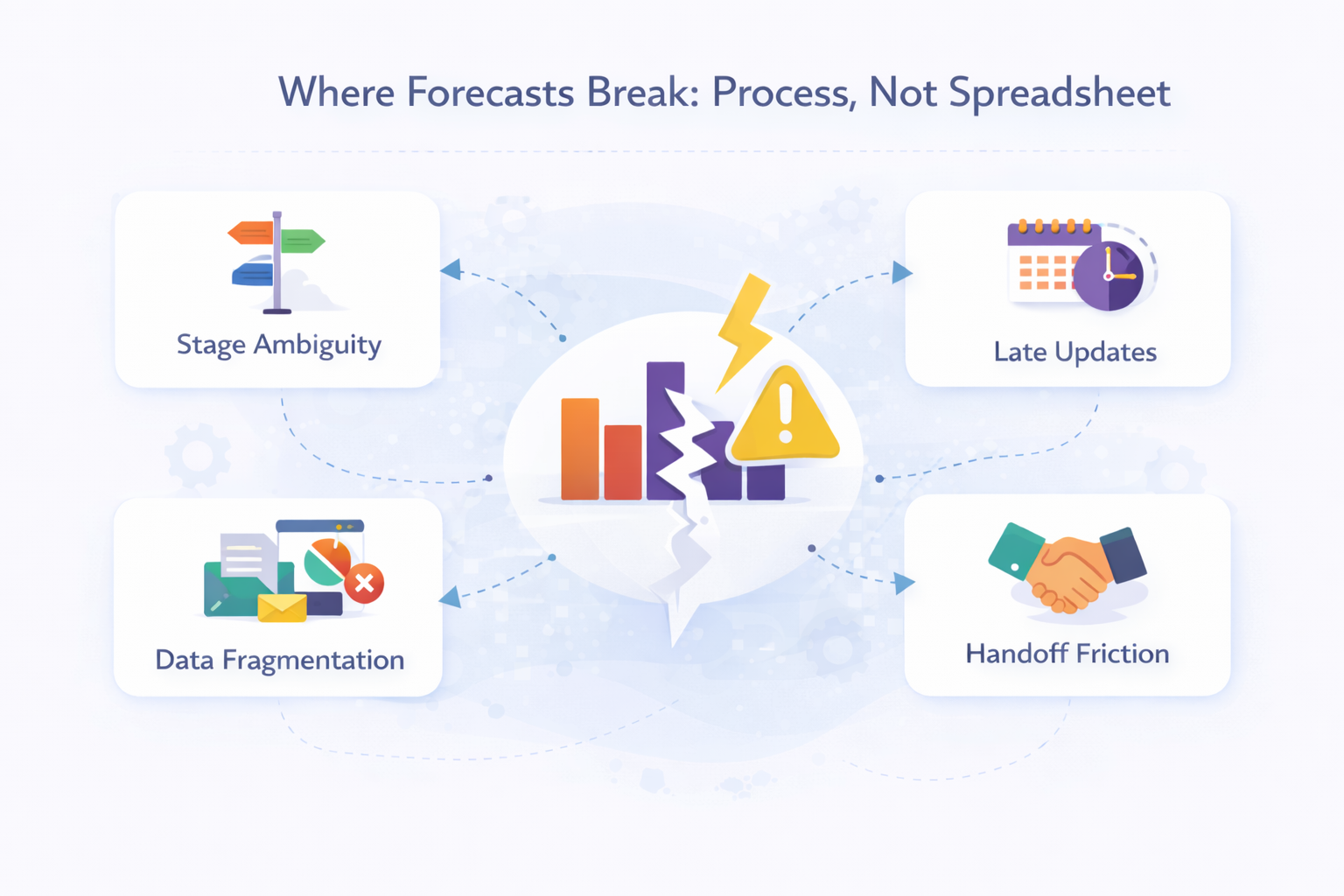
Where forecasts break: process, not spreadsheet
Forecasting fails when the underlying operational process cannot produce reliable signals. Most forecast challenges are symptoms of process breakdowns in upstream workflows.
Common failure points include:
- Stage ambiguity: teams interpret pipeline stages differently, inflating confidence
- Late updates: CRM data lags reality, creating false visibility
- Handoff friction: marketing, sales, and service operate on different definitions
- Unstructured exceptions: discounting, renewals, and approvals happen outside systems
- Data fragmentation: key data lives in email threads, sheets, and disconnected tools
Fixing this requires moving beyond diagrams into operational enforcement. That transition is unpacked in our guide on turning process design into execution that actually scales.
Forecast confidence improves when your processes produce consistent, timely, and comparable signals. Finance cannot forecast what the business cannot measure.
The CFO control model: definitions, governance, and system signals
CFOs should treat revenue systems like financial systems: governed, defined, and auditable. The most practical control model has three layers.
1. Standardise definitions
Agree on what constitutes a lead, an opportunity, a qualified stage, a renewal risk, churn, and expansion. Define what must be true for an opportunity to move stages.
2. Enforce governance
Make ownership explicit. If stage movement is ungoverned, forecasts become opinion. Governance introduces accountability and reduces leadership debates.
3. Build reliable system signals
Your CRM and connected platforms should surface operational signals early, not late. That requires disciplined processes and clean data.
Process design is the foundation. If you need a refresher on how to build it properly, revisit our breakdown of business process design as a growth lever.
Finance teams can then implement controls such as:
- Stage entry criteria and automated validation
- Approval workflows for discounting and non-standard terms
- Mandatory fields that prevent “empty pipeline” reporting
- Standardised deal reason codes for wins and losses
- Governed reporting layers that reduce spreadsheet dependency
Revenue leakage is often a finance visibility problem
Revenue leakage rarely appears as a single obvious failure. It shows up as a pattern:
- Deals slipping without early warning
- Discounting increasing to compensate for weak positioning
- Renewals becoming reactive instead of proactive
- Customer acquisition costs rising without clear attribution
- Forecast misses becoming normalised
This is why RevOps matters to CFOs. RevOps is the discipline that aligns operational workflows with revenue outcomes and reporting confidence.
If you want a practical execution model, this 90-day RevOps roadmap for fixing revenue leaks provides a structured approach CFOs can sponsor and measure.
When CFOs sponsor RevOps work, the benefit is not just growth. It is improved margin, reduced waste, and stronger predictability.
How CFOs should partner with ops and revenue teams
In many organisations, finance is treated as a downstream function that validates results after decisions are made. High-performing organisations treat finance as a strategic operating partner that influences system design.
CFOs can lead by:
- Owning the definition layer for lifecycle stages, revenue metrics, and pipeline governance
- Driving alignment between forecasting, attribution, and operational inputs
- Requiring systems-based reporting rather than spreadsheet reconciliation
- Funding the unglamorous work: data quality, process enforcement, and operational discipline
Segmentation also matters here. When customer and account data is clean and structured, finance can model churn risk, expansion potential, and cohort profitability with more confidence. If you want to connect customer structure to operational outcomes, this guide to advanced customer segmentation shows why data discipline pays off commercially.
Finally, if your finance function itself is under pressure from the same operational noise, revisit our perspective on modern finance transformation and how it ties into operational redesign.
Conclusion: CFOs don’t just report the business — they shape it
Forecast accuracy is not a finance-only problem. It is a systems problem. Finance can only be as accurate as the operational inputs it receives.
For CFOs of mid-sized businesses, the opportunity is clear: sponsor the operating system, not just the reporting layer. That means investing in process design, enforcing data governance, and partnering with revenue teams to turn operational signals into predictability.
When finance leads operational clarity, forecasting improves, margin improves, and leadership confidence increases. This is not just better reporting. It is better control.

FAQs
1. Why do forecasts become less reliable as a business grows?
Because growth introduces more handoffs, more tools, and more variability in how teams define and update pipeline data. Forecasting breaks when operational signals are inconsistent or delayed.
2. What is the CFO’s role in RevOps?
The CFO should own governance around revenue definitions, reporting standards, and accountability. RevOps then operationalises those standards across systems and teams.
3. How can a CFO reduce “spreadsheet forecasting” dependency?
By enforcing stage criteria, improving CRM data quality, standardising definitions, and building governed reporting layers that teams trust and adopt.
4. What are the most common sources of revenue leakage?
Untracked churn risk, inconsistent follow-up, uncontrolled discounting, weak handoffs between teams, and poor visibility into pipeline health and deal progression.
5. How does segmentation help finance?
Clean segmentation improves cohort analysis, churn modelling, expansion forecasting, and profitability insights by ensuring customer data is reliable and comparable across systems.