
Process design is where operational clarity begins. But real transformation happens when those processes are implemented, measured, and continuously improved. In this follow-up article, we explore how businesses move from designing better workflows to building operational systems that scale with growth.
If your organisation has already started mapping workflows and identifying friction points, the next challenge is execution. This article expands on our earlier insights around business process design and analysis as a hidden growth lever and shows how to turn strategic thinking into measurable outcomes.
-1.jpg?width=2000&height=1128&name=Velocity%20Blog%20Featured%20Images%20(1)-1.jpg)
Covered in this article
From Process Design to Process Execution
Why Most Process Improvements Stall
Operationalising Process Changes Across Teams
The Role of Data, Segmentation, and Revenue Visibility
Building a Continuous Improvement Engine
Conclusion

From Process Design to Process Execution
Designing a process is only the first step. Many businesses invest time in mapping workflows but fail to translate those diagrams into real operational change. The difference between intention and impact lies in execution discipline.
Execution requires:
- Clear ownership of each process stage
- Alignment between teams and systems
- Standardised workflows inside CRM and operational platforms
- Defined performance metrics that track success
Without these elements, even the most well-planned framework quickly reverts to old habits, creating the same inefficiencies that process design aimed to eliminate.
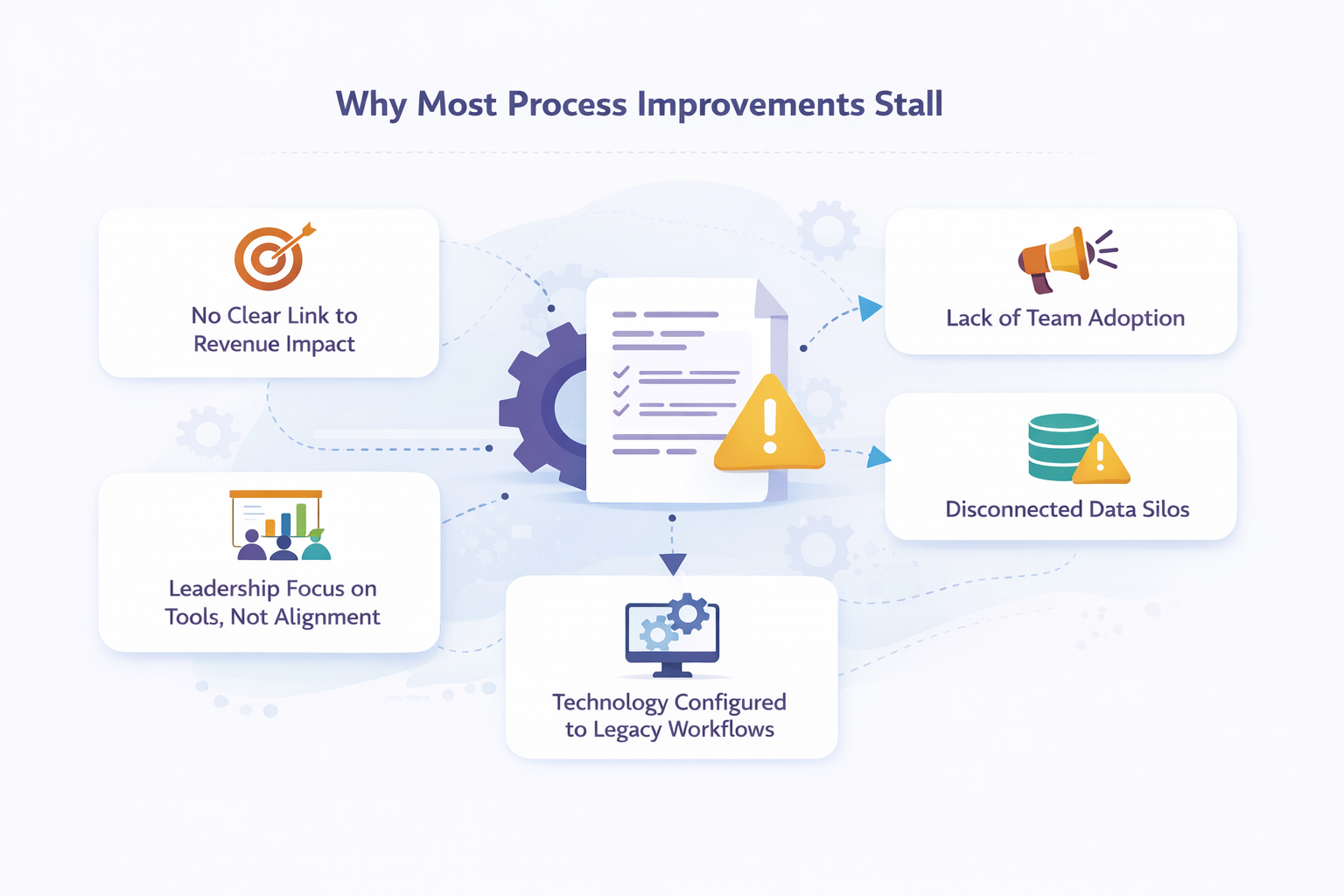
Why Most Process Improvements Stall
Process redesign often loses momentum because organisations underestimate how deeply processes are embedded in daily behaviour. Teams default to familiar patterns, especially when systems do not reinforce the new structure.
Common causes include:
- No clear link between process change and revenue outcomes
- Lack of adoption by frontline teams
- Disconnected data and reporting frameworks
- Technology configured around legacy workflows
- Leadership focusing on tools instead of operational alignment
These challenges become more visible as organisations scale. In fact, businesses facing increasing operational pressure often discover that revenue complexity grows faster than systems can adapt, making structured process execution essential.
Operationalising Process Changes Across Teams
Successful execution requires translating process design into behaviours and systems that teams can follow naturally. This means integrating workflows into daily operations rather than relying on documentation alone.
1. Align Sales, Marketing, and Operations
Processes fail when departments optimise independently. Cross-functional alignment ensures that leads, customers, and operational data move seamlessly across the lifecycle.
2. Build Playbooks That Reflect Reality
Operational playbooks should reflect how teams actually work rather than how leadership assumes they work. This creates consistency without reducing flexibility.
3. Embed Process Inside Systems
CRM and automation tools should enforce the process through structured stages, required fields, and defined triggers. This is where many organisations benefit from structured CRM implementation and optimisation efforts.
When executed properly, process alignment creates measurable gains, similar to those highlighted in practical RevOps roadmaps focused on fixing revenue leaks.
The Role of Data, Segmentation, and Revenue Visibility
Process execution is impossible without reliable data. When teams operate with inconsistent data definitions or fragmented systems, processes break down quickly.
Modern organisations combine process design with data strategy to create operational intelligence. For example:
- Customer lifecycle stages aligned with operational workflows
- Clear attribution models linked to process steps
- Behavioural segmentation informing engagement timing
- Standardised reporting for leadership decision-making
Advanced segmentation strategies, like those discussed in this guide to advanced customer segmentation, further strengthen process execution by ensuring teams act on meaningful behavioural insights instead of generic data.
When data and process align, organisations gain predictable visibility into pipeline health and operational performance.
Building a Continuous Improvement Engine
The strongest organisations treat process design as an ongoing discipline, not a one-time project. Continuous improvement creates resilience and allows teams to adapt as markets evolve.
A practical continuous improvement cycle includes:
- Quarterly process reviews linked to performance metrics
- Feedback loops between frontline teams and leadership
- Regular audits to identify process drift
- Optimisation based on measurable outcomes
Many organisations formalise this approach through structured assessments like RevOps audits that uncover system and workflow gaps, ensuring process improvements remain aligned with growth objectives.
Conclusion: Processes That Scale, Systems That Support Growth
Designing better processes is a strategic advantage. Executing them consistently is what drives measurable business results.
The organisations that scale successfully are not those with the most tools, but those with the clearest operational design supported by data, systems, and accountability. When process execution becomes part of everyday operations, revenue predictability improves, teams collaborate more effectively, and leadership gains greater confidence in decision-making.
If your organisation has already started redesigning processes, the next step is ensuring they are embedded into the way your teams work every day. That is where operational maturity begins.