
Your marketing team is generating leads, campaign engagement is increasing and the sales pipeline appears healthy. Individual departmental targets are being met, yet revenue forecasts continue to fall short. For many businesses, the immediate response is to increase marketing budgets, generate more leads or place additional pressure on the sales team. However, the underlying problem may have very little to do with the volume of marketing activity or the effort being invested by sales.

Revenue leakage often occurs in the space between these two functions, where customer information, buying intent, ownership and accountability are transferred from one team to another. These gaps can remain undetected for months or even years because marketing and sales are frequently measured against different performance indicators, with neither department having complete visibility of the customer journey.
Before investing more money in customer acquisition, businesses should consider whether their existing revenue funnel is effectively converting the opportunities they are already generating.
What Is Revenue Leakage?
Within the context of marketing and sales, revenue leakage refers to preventable losses of potential revenue caused by inefficiencies, disconnected processes, inconsistent data or missed opportunities throughout the customer journey.
Not every lead that fails to convert represents revenue leakage. Some prospects will naturally be unsuitable, choose a competitor or decide against making a purchase. The concern arises when commercially viable opportunities are lost because of circumstances the organisation could have influenced or prevented.
These losses can occur when qualified leads receive no follow-up, prospects are assigned to the wrong sales representative, customer information is incomplete or promising opportunities become dormant without any intervention. Individually, these incidents may appear insignificant, but their cumulative impact can become substantial when repeated across hundreds or thousands of customer interactions.
This is why Revenue Operations (RevOps) and Revenue Funnel Alignment have become important considerations for businesses looking to improve the commercial effectiveness of their marketing and sales investments.
The Disconnect Between Marketing Success and Sales Success
One of the fundamental challenges facing revenue-generating teams is that marketing and sales often operate with different definitions of success.
Marketing departments are typically measured against reach, engagement, website traffic, lead volume and cost per acquisition, while sales teams are evaluated against pipeline value, conversion rates, closed deals and revenue targets. Although these metrics serve legitimate purposes, they can encourage teams to optimise their individual performance without necessarily improving the overall commercial outcome.
For example, a marketing campaign may generate a large number of leads at an exceptionally low cost. From a campaign performance perspective, this appears to be a successful investment. However, if those leads do not match the company's ideal customer profile, lack genuine buying intent or are not ready to engage with a sales representative, the commercial value of the campaign may be considerably lower than the marketing dashboard suggests.
The reverse is equally problematic. Marketing may generate high-quality opportunities that fail to convert because sales representatives receive insufficient customer context, respond too slowly or lack an effective follow-up process.
In both scenarios, departmental reporting can create the impression that one team is performing while the other is underperforming. In reality, the business may be dealing with a structural problem that requires greater alignment rather than increased pressure on either department.
Seven Places Where Revenue Leaks Between Marketing and Sales
1. Marketing Is Optimising for Leads Instead of Revenue
Generating leads is an important marketing objective, but lead volume alone provides limited insight into commercial performance. When campaigns are optimised exclusively around reducing cost per lead or increasing enquiry volumes, marketing teams may unintentionally attract audiences that are less likely to become customers.
Consider two hypothetical campaigns:
| Performance metric | Campaign A | Campaign B |
|---|---|---|
| Marketing investment | R30,000 | R30,000 |
| Leads generated | 300 | 100 |
| Cost per lead | R100 | R300 |
| Customers acquired | 3 | 10 |
| Average deal value | R50,000 | R50,000 |
| Revenue generated | R150,000 | R500,000 |
| Marketing cost per customer acquired | R10,000 | R3,000 |
| Revenue-to-ad-spend ratio | 5:1 | 16.7:1 |
Based exclusively on lead volume and cost per lead, Campaign A appears significantly more successful. However, Campaign B generates more than three times the revenue from the same marketing investment.
While this simplified example excludes sales costs and other operational expenses, it illustrates why campaign performance should be evaluated beyond initial acquisition metrics. Connecting marketing investment to qualified opportunities and closed revenue allows businesses to make more informed decisions about where to allocate their budgets.
2. Marketing and Sales Disagree on What Constitutes a Qualified Lead
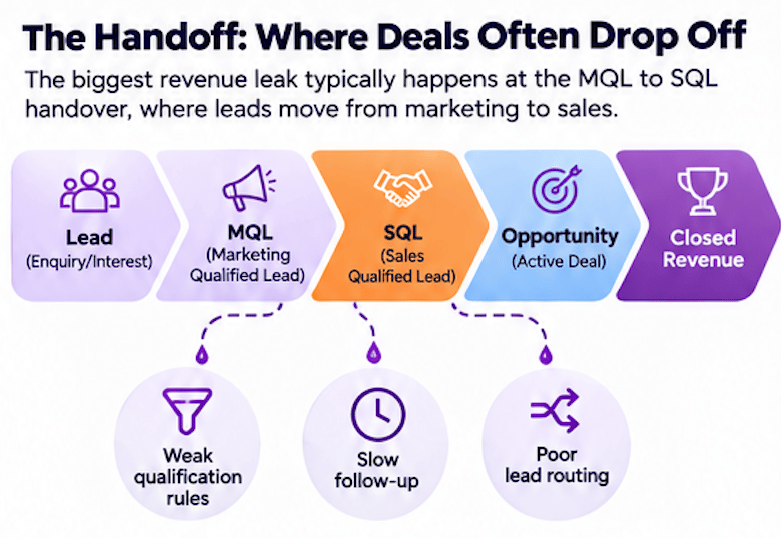
The transition from Marketing Qualified Lead (MQL) to Sales Qualified Lead (SQL) is one of the most important stages of a B2B revenue funnel, yet it is frequently undermined by inconsistent qualification criteria.
Marketing may consider a prospect qualified because they downloaded a guide, attended a webinar or engaged repeatedly with website content. Sales, however, may require evidence of a genuine business need, sufficient budget, decision-making authority or an appropriate purchasing timeframe before considering the same prospect a viable opportunity.
Neither perspective is inherently incorrect, but when these definitions are not aligned, businesses create unnecessary friction. Sales representatives may spend time pursuing prospects who were never ready to buy, while marketing receives limited feedback about why the leads it generates are not progressing.
Effective lead qualification should consider both customer fit and buying intent, supported by agreed criteria that determine when a prospect should move between lifecycle stages.
Our article on defining HubSpot lifecycle stages that sales and marketing agree on explores how businesses can create shared definitions and reduce ambiguity throughout this process.
3. Leads Lose Momentum During the Sales Handover
Consumer attention and buying intent are not permanent. When someone submits an enquiry, requests a demonstration or asks for a quotation, they are demonstrating interest at a particular moment in time. The longer a business takes to acknowledge and respond to that interest, the greater the opportunity for the prospect to reconsider, become distracted or continue exploring alternative providers.
This is particularly relevant in an increasingly digital-first business environment, where consumers have become accustomed to convenient communication, immediate access to information and relatively streamlined experiences.
Businesses often invest considerable resources in attracting prospects but pay insufficient attention to what happens immediately after a lead is generated. An enquiry may sit in a shared inbox, wait for manual assignment or remain uncontacted because responsibility has not been clearly established.
Reducing revenue leakage at this stage requires a documented service level agreement (SLA) between marketing and sales, with agreed response times, ownership responsibilities, follow-up requirements and escalation procedures.
Automated lead assignment, internal notifications and reminders can support this process, but the underlying responsibilities need to be established before automation is introduced. As discussed in our guide to the sales and marketing handoff that costs businesses deals, a successful handover depends on clear operational agreements supported by reliable technology.
4. Customer Context Is Lost Between Departments
Every interaction a prospect has with a business contributes to a developing understanding of their needs and interests. The pages they visit, content they consume, events they attend and enquiries they submit can all provide valuable context when initiating a sales conversation.
However, marketing and sales frequently operate across different systems or maintain separate views of customer information. As a result, sales representatives may approach prospects without understanding what originally attracted their attention or what problem they are looking to solve.
Imagine a potential customer who has attended a webinar on workflow automation, downloaded an AI implementation guide and submitted an enquiry about integrating existing business systems. If the sales representative receives only a name, email address and telephone number, much of the context that could inform a meaningful conversation has been lost.
The prospect may then be required to repeat information they have already provided, creating unnecessary friction and potentially undermining confidence in the business.
An effectively implemented CRM can preserve relevant customer interaction history, campaign engagement and qualification information, enabling sales teams to continue the customer journey rather than restarting it.
Through CRM Implementation & Optimisation, businesses can establish a more connected approach to managing customer information across departments.
5. Prospects Who Are Not Ready to Buy Are Abandoned
Not every qualified prospect is ready to enter an immediate sales conversation. Purchasing decisions, particularly within B2B environments, may be influenced by budgeting cycles, internal approvals, procurement requirements, changing business priorities and the involvement of multiple decision-makers.
A prospect who is unsuitable for immediate sales engagement may still represent a valuable future opportunity. Unfortunately, many businesses treat leads as either ready to pursue or no longer worth pursuing, leaving limited room for prospects whose purchasing intentions are genuine but whose timing is not aligned with the current sales cycle.
This is where marketing automation and lead nurturing become particularly valuable. Prospects who are not yet ready to progress can be returned to appropriately segmented communication programmes, receiving relevant educational content, industry insights and product information until their circumstances change.
Establishing a structured lead recycling process also helps sales teams focus on immediate opportunities without permanently removing longer-term prospects from the revenue ecosystem. Where electronic marketing is involved, these communications should be managed in accordance with applicable consent and data protection requirements.
6. Your Sales Pipeline Contains Opportunities That Are No Longer Viable
A large pipeline does not necessarily indicate a healthy pipeline. Inconsistent deal management can leave outdated opportunities, unrealistic closing dates and inactive prospects in the CRM, creating an inflated view of potential future revenue.
Leadership teams may make decisions about budgets, staffing and business expansion based on forecasts that include opportunities with little realistic prospect of closing.
This problem often develops gradually when sales representatives use different criteria to move deals between stages, update opportunities inconsistently or fail to record why deals have stalled.
Improving pipeline quality requires clear entry and exit criteria for each deal stage, regular pipeline reviews and consistent documentation of next steps. Businesses should also monitor how long opportunities remain in individual stages and establish processes for identifying deals that require intervention, renewed qualification or removal from active forecasts.
A reliable pipeline should reflect the reality of customer purchasing decisions rather than simply the value of opportunities recorded in the CRM.
7. Disconnected Reporting Prevents Leadership From Seeing the Full Picture
Revenue leakage becomes particularly difficult to identify when marketing, sales and leadership rely on separate reporting environments.
Marketing may understand which campaigns generate enquiries, while sales knows which representatives close deals. Finance has visibility of actual revenue, but the relationships between these activities may be unclear.
Without consistent data, shared definitions and connected reporting, businesses struggle to answer fundamental questions:
- Which marketing campaigns generate the most profitable customers?
- What percentage of qualified leads receive timely follow-up?
- Where do commercially viable opportunities stop progressing?
- Which lead sources produce the strongest sales conversion rates?
- How accurate are revenue forecasts compared with actual performance?
These questions cannot always be answered through individual departmental dashboards. They require a connected view of the customer journey, supported by consistent CRM data, appropriate attribution methods and reporting that reflects shared commercial objectives.
How to Identify Revenue Leakage in Your Own Funnel
Before implementing new technology or restructuring departments, businesses should establish where opportunities are being lost and whether those losses could reasonably have been prevented.
A revenue funnel audit provides a structured way to assess the effectiveness of existing processes.
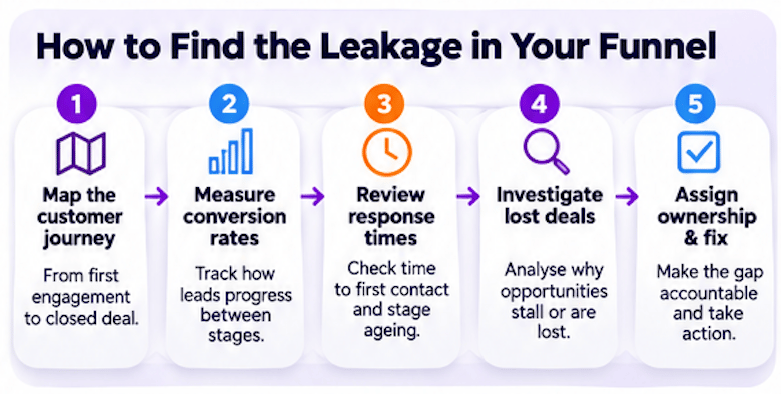
In our article on what we look at during a RevOps audit, we explore how evaluating existing systems, pipeline quality and operational processes can reveal structural issues before businesses invest in further growth initiatives.
The Metrics Every Revenue Team Should Be Tracking
A connected revenue funnel requires more than traditional marketing and sales performance indicators. Businesses should establish shared metrics that help identify how effectively customer opportunities move between departments.
| Metric | What it helps identify |
|---|---|
| MQL-to-SQL conversion rate | Whether marketing qualification aligns with sales requirements. |
| Lead acceptance rate | Whether leads transferred to sales meet agreed acceptance criteria. |
| Time to first contact | Delays between an enquiry or handover and meaningful sales engagement. |
| Uncontacted lead rate | Opportunities that receive no recorded sales outreach. |
| Lead-to-opportunity conversion rate | Whether leads progress into genuine commercial opportunities. |
| Sales stage ageing | Opportunities that remain inactive or stalled within the pipeline. |
| Opportunity win rate | How effectively the business converts sales opportunities into customers. |
| Customer acquisition cost | The combined cost of acquiring new customers through marketing and sales. |
| Revenue by lead source | Which acquisition channels contribute to actual commercial outcomes. |
| Forecast accuracy | How closely predicted revenue reflects actual business performance. |
These metrics are most valuable when considered collectively rather than in isolation. For example, a declining MQL-to-SQL conversion rate may indicate poor lead quality, but it could also reflect delayed follow-up or inconsistent sales acceptance criteria. Understanding the relationship between metrics provides a more useful foundation for decision-making than relying on any single performance indicator.
How RevOps Helps Prevent Revenue Leakage
Revenue Operations, commonly referred to as RevOps, is a strategic approach that aligns the people, processes, technology and data involved in generating and retaining revenue.
Rather than treating marketing, sales and customer service as independent business functions, RevOps establishes a shared operating framework in which each department contributes to the broader commercial objectives of the organisation.
An effective RevOps strategy typically brings together:
- Shared lifecycle stages and lead qualification criteria.
- Clearly defined ownership and departmental handover processes.
- Integrated CRM systems and reliable customer data.
- Marketing automation, lead routing and sales workflows.
- Consistent pipeline management and forecasting practices.
- Shared reporting and revenue-focused performance indicators.
For South African businesses looking to grow without continuously expanding their teams or marketing budgets, this approach can help identify opportunities to improve the return on existing resources. Instead of relying exclusively on increased campaign investment, businesses can focus on improving how effectively their existing opportunities are managed and converted.
Importantly, implementing a CRM does not automatically create alignment between departments. The technology needs to reflect agreed business processes, and those processes must be consistently understood and adopted by the people using it.
Before You Increase Your Marketing Budget, Fix Your Revenue Funnel
When revenue targets are not being met, generating more leads may appear to be the most logical solution. However, increasing acquisition volumes without addressing structural inefficiencies can result in additional marketing expenditure, greater pressure on sales teams and more opportunities being lost through the same gaps.
At Velocity Digital, we help businesses identify and address these challenges through our RevOps & Revenue Funnel Alignment and CRM Implementation & Optimisation services.
Whether your organisation is already using HubSpot or is considering a more connected approach to revenue management, our team can assess your existing CRM environment, qualification processes, sales pipelines, automated workflows and reporting structures to identify where commercially valuable opportunities are being lost.
The objective is not simply to generate more leads or introduce more technology. It is to create a revenue ecosystem in which marketing investment, sales activity and operational processes work together to support measurable, sustainable business growth.
Are you confident that your business is converting the opportunities it is already generating?
Connect with Velocity Digital to explore how a RevOps assessment or HubSpot CRM audit can help you identify revenue leakage and build a more effective revenue funnel.
Frequently Asked Questions
What is revenue leakage between marketing and sales?
Revenue leakage between marketing and sales refers to preventable losses of potential revenue resulting from operational inefficiencies, inconsistent qualification criteria, delayed follow-up, poor lead management or disconnected customer information. It occurs when commercially viable opportunities fail to progress because of gaps that the business could address.
What is a good MQL-to-SQL conversion rate?
There is no universal MQL-to-SQL conversion benchmark that applies to every business. Appropriate conversion rates depend on the industry, target audience, purchasing cycle and qualification criteria. Businesses should establish their own performance baseline and evaluate conversion rates alongside lead acceptance, response times, opportunity creation and closed revenue.
How can HubSpot help reduce revenue leakage?
HubSpot can help businesses centralise customer information, standardise lifecycle stages, automate lead assignment, manage sales pipelines and connect marketing activity with revenue reporting. Its effectiveness depends on appropriate configuration, reliable data and consistent adoption across departments.
What is the difference between RevOps and sales operations?
Sales operations focuses primarily on improving the efficiency and effectiveness of the sales function. Revenue Operations takes a broader approach by aligning marketing, sales, customer service and supporting business systems around shared revenue objectives.
Can businesses increase revenue without increasing marketing spend?
Potentially, yes. Businesses with significant revenue leakage may be able to improve commercial performance by strengthening lead qualification, follow-up processes, conversion rates, CRM data quality and pipeline management. The extent of any improvement depends on the nature and scale of the existing inefficiencies.