---
title: What Is RevOps? The Framework Behind Predictable Growth
description: What is RevOps? Learn how revenue operations align sales, marketing and finance to improve forecasting, pipeline visibility and growth.
image: https://velocity.digital/hubfs/Velocity%20Blog%20Featured%20Images-1.jpg
---
[](https://velocity.digital/)
- [Home](https://velocity.digital)
- Our Culture
- [Why choose Velocity?](https://velocity.digital/why-choose-velocity)
- [Our Team](https://velocity.digital/our-team)
- [Careers](https://velocity.digital/jobs)
- Services
- Revenue Growth Engine
- [Digital Campaign Strategy & Lead Generation](https://velocity.digital/digital-campaign-strategy-lead-generation)
- [RevOps & Revenue Funnel Alignment](https://velocity.digital/revops-revenue-funnel-alignmentand)
- [CRM Implementation & Onboarding](https://velocity.digital/crm-implementation-onboarding)
- AI & Automation Services
- [Process & Workflow Automation](https://velocity.digital/process-and-workflow-automation)
- [AI Readiness Assessment & Strategy](https://velocity.digital/ai-readiness-assessment-and-strategy)
- Localised Marketing
- [Smart City Portals](https://velocity.digital/city-sites-joburg-and-pretoria)
- Resources
- [SMB Onboarding Packages](https://velocity.digital/crm-implementation-optimisation#SMB_Packages)
- [Blog](https://velocity.digital/latest-news)
- [Video Hub](https://velocity.digital/video-hub)
- [Events](https://velocity.digital/events)
[CONTACT US](https://velocity.digital/contact)
# What Is RevOps? The Framework Behind Predictable Growth
- [Home](https://velocity.digital)
- [Blog](https://velocity.digital/latest-news)
What Is RevOps? The Framework Behind Predictable Growth
Revenue Operations (RevOps) is a strategic framework that aligns sales, marketing, customer success and finance around a shared revenue system. In practice, that means your CRM data, lifecycle stages, reporting and forecasting models all work together, so decisions are driven by one operational truth, not competing spreadsheets and siloed dashboards.
Most growth problems that show up as “pipeline issues” are actually operational issues. Leads enter the business, handoffs break, definitions differ, finance cannot trust the numbers, and leaders end up managing revenue through debate instead of evidence. The result is inconsistent forecasting, slower execution, and invisible revenue leakage across the quote-to-cash journey.
This guide is written for revenue leaders, RevOps and Marketing Ops practitioners, Sales leadership, and CFOs or CXOs who need clarity on what RevOps is, what it does, and why modern organisations invest in it. You will learn the core components of a RevOps system, how it improves forecast accuracy, how it differs from Sales Ops and Marketing Ops, and what “good” looks like when RevOps becomes an operating model for predictable growth.

## Covered in this article
What Is RevOps? (Revenue Operations Explained)
Why Traditional Revenue Teams Struggle Without RevOps
How the RevOps Framework Aligns Sales, Marketing and Finance
Lifecycle Stages Managed Through Revenue Operations
How RevOps Improves Forecast Accuracy
RevOps vs Sales Ops: What’s the Difference?
The Role of Data, CRM and Automation in RevOps
How Finance Benefits from a Revenue Operations Model
Common Signs Your Organisation Needs RevOps
How to Implement RevOps Without Breaking Existing Systems
The Future of RevOps: AI, Predictability and Operational Design
Frequently Asked Questions About RevOps
## What Is RevOps?
**Answer:** RevOps is a revenue operating model that aligns CRM systems, marketing automation, sales processes and customer success data to improve revenue predictability. It standardises lifecycle stages, removes operational friction between teams, and produces consistent reporting so leadership can forecast and scale growth with confidence.
**In simple terms:** RevOps connects the people, process and technology behind revenue into one measurable system, so teams stop optimising in isolation and start improving the whole revenue lifecycle.
RevOps is not a “new department name” for an existing operations team. It is a cross-functional framework that defines how revenue moves through your organisation, how it is measured, and how it is improved. In most B2B organisations, RevOps sits at the intersection of CRM governance, lifecycle design, revenue reporting, enablement workflows, and forecasting methodology.
[](https://velocity.digital/hs/cta/wi/redirect?encryptedPayload=AVxigLLAXevtUCEdBFGKZEraK98lbxI5l7OyZ6oYbKly7Z5ttaVLt6oItTA4BnAajnJPauAjGCItHCrok7nglUBvGBF7mJZ9RswzmuIGC4zL%2BDb8STVq4dKvqyP1sj%2B%2FdlYMDEtaLRRubmvTAln%2FUQkwKbWZ%2B86RlzIDztEnPbHe6jdrjaYD&webInteractiveContentId=196658812810&portalId=6066958)
## What Does RevOps Actually Do?
RevOps exists to make revenue performance predictable by turning messy execution into an operational system. That system is built on consistent definitions, clean data, and workflows that support how buyers actually move from first touch to closed-won and renewal.
### Core responsibilities of RevOps
- **Pipeline visibility:** Ensuring every stage has clear entry and exit criteria, with reliable pipeline reporting.
- **Lifecycle design:** Defining lifecycle stages (lead, MQL, SQL, opportunity, customer) and enforcing consistent movement rules.
- **CRM governance:** Standardising data properties, ownership, permissions, and reporting logic in your CRM.
- **Handoff and automation:** Building workflows for lead routing, SLA enforcement, follow-up sequences, and customer onboarding triggers.
- **Revenue analytics:** Creating dashboards that tell the same story across sales, marketing, customer success and finance.
- **Forecasting operations:** Aligning pipeline signals, conversion rates and operational realities to improve forecast accuracy.
### Typical systems RevOps aligns
- CRM (for example, HubSpot CRM)
- Marketing automation and email workflows
- Sales engagement and prospecting tooling
- Deal desk and quote-to-cash processes
- Billing or finance systems (where relevant)
- Reporting layers, dashboards, and BI tools
## Why Revenue Teams Break as Companies Grow
When a business is small, revenue “works” because everyone knows what is happening. As volume increases, informal coordination breaks, and the organisation becomes dependent on systems, definitions and processes that were never designed for scale.
### Sales, marketing and finance start operating in silos
Marketing measures demand and lead volume. Sales measures opportunities and close rates. Finance measures recognised revenue and cash flow. When each team owns a different dataset and a different definition of success, forecasting becomes political. Leaders spend more time reconciling numbers than improving performance.
### Operational friction creates revenue leakage
Revenue leakage rarely looks like one dramatic failure. It looks like a thousand small ones: incomplete data, unclear ownership, slow follow-up, inconsistent discounting, broken handoffs, and untracked status changes. Many of these issues show up inside the quote-to-cash chain. If your organisation sees recurring friction between quoting, approvals, invoicing and customer onboarding, read our breakdown of [why quote-to-cash systems keep breaking](https://velocity.digital/latest-news/why-your-quote-to-cash-system-keeps-breaking).
### Forecasting becomes unreliable
Forecasts collapse when pipeline stages are not real stages, when conversion rates are not stable, and when CRM data is incomplete or inconsistent. In fast-growing teams, it is common for “forecasting” to become a weekly negotiation instead of an operational output.
## The Four Pillars of a RevOps System
High-performing RevOps functions are built on a simple premise: predictable revenue requires predictable operations. The most effective RevOps systems typically stabilise four pillars: data alignment, lifecycle design, automation, and revenue analytics.
### 1) Data and CRM alignment
RevOps treats your CRM as a revenue system, not a contact database. That means defining required properties, ownership rules, and data quality controls so reporting can be trusted. When the CRM becomes the single source of truth, every team can operate from the same reality.
### 2) Lifecycle stage design
Lifecycle stages are the language of revenue. RevOps defines what each stage means, what qualifies a record to move forward, and what actions must happen at each step. This prevents inflated pipeline, improves handoffs, and makes performance bottlenecks visible.
### 3) Process automation and handoffs
RevOps uses automation to enforce operational consistency. That includes lead routing, SLA timers, task creation, deal stage prompts, renewal reminders, and customer success triggers. The goal is not “more automation” but fewer gaps where revenue can fall through.
### 4) Revenue analytics and forecasting
RevOps builds reporting that links activity to outcomes. Instead of disconnected dashboards, you get one revenue narrative across funnel performance, pipeline movement, conversion rates, sales cycle length, retention signals and forecast confidence. If you want a deeper explanation of where forecasting breaks in practice, read [how revenue forecasting breaks from pipeline to predictability](https://velocity.digital/latest-news/from-pipeline-to-predictability-how-revenue-forecasting-breaks).
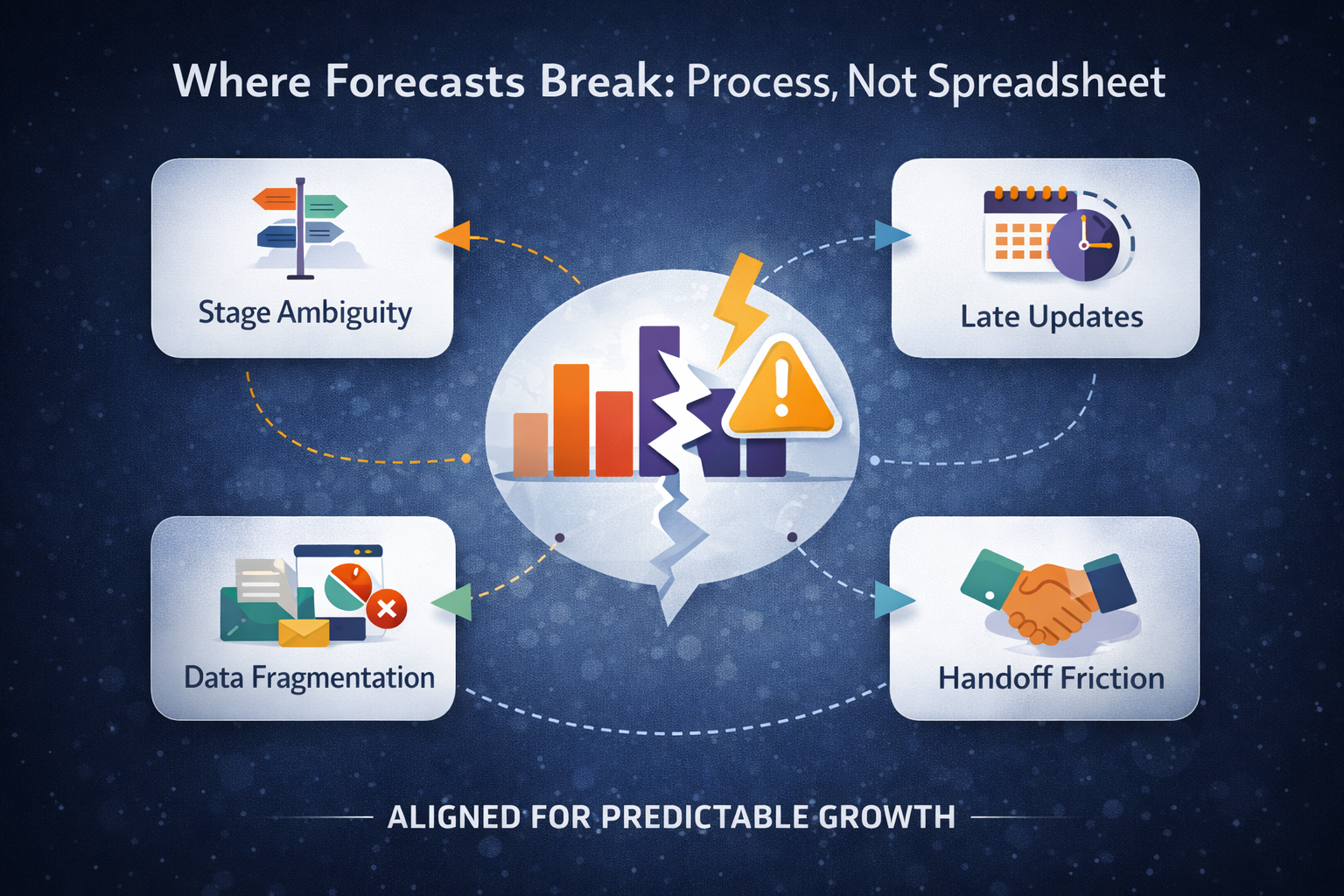
RevOps aligns teams and systems into one revenue operating model.
## How RevOps Improves Forecast Accuracy
**Answer:** RevOps improves forecast accuracy by connecting pipeline activity, lifecycle stages and operational workflows into one measurable system rather than relying on disconnected departmental reports. When CRM data is governed and stages reflect reality, forecasting becomes an operational output, not a weekly argument.
Most forecast failures are not caused by “bad salespeople” or “market uncertainty”. They are caused by operational design issues: inconsistent definitions, poor data capture, ungoverned discounting, and pipeline stages that do not represent real buyer progress.
### Operational design is the missing layer
Forecast reliability increases when operational design is intentional: lifecycle definitions, stage criteria, required fields, and workflow enforcement. This is why finance leaders increasingly view RevOps as a forecasting discipline, not just an operations discipline. If forecast reliability is a priority, our CFO-focused guide on [forecast accuracy through operational design](https://velocity.digital/latest-news/cfo-guide-to-forecast-accuracy-through-operational-design) breaks down the structural changes that move forecasts from opinion to evidence.
### Predictability beats optimism
RevOps is not about “making the number look better”. It is about making performance measurable so leadership can confidently invest in growth. Predictability creates operational leverage: hiring plans improve, marketing spend becomes defensible, and revenue targets become executable.
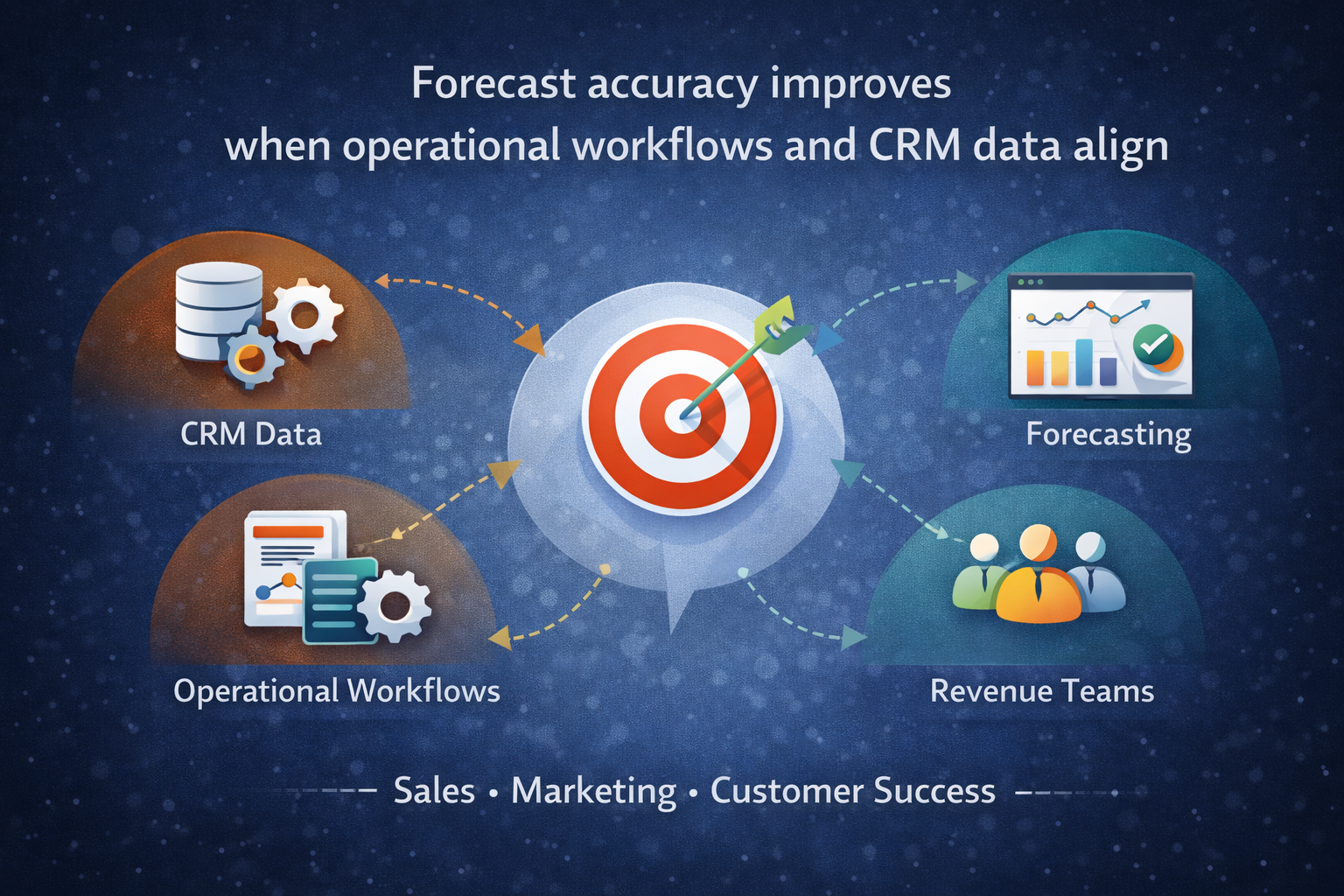
Forecast accuracy improves when operational workflows and CRM data align.
## RevOps vs Sales Ops vs Marketing Ops
**Answer:** Sales Ops focuses on sales efficiency and performance, Marketing Ops focuses on campaign execution and marketing systems, and RevOps aligns sales, marketing, finance and customer success into one end-to-end revenue system. RevOps optimises the full revenue lifecycle, not a single function.
The confusion usually comes from overlap. RevOps does not replace Sales Ops or Marketing Ops. It integrates them into a shared operating model with consistent definitions, shared reporting, and unified process design.
| Function | Primary focus | Typical scope | Key outputs |
| --- | --- | --- | --- |
| Sales Ops | Sales productivity and execution | Pipeline process, enablement, tooling | Sales dashboards, process adherence, performance improvements |
| Marketing Ops | Marketing execution and measurement | Automation, campaigns, attribution | Lead flow, campaign reporting, nurture workflows |
| RevOps | Revenue predictability and alignment | End-to-end lifecycle, cross-functional systems | Unified reporting, forecasting confidence, operational clarity |
## Why Finance Leaders Are Investing in RevOps
Finance has always cared about predictability. What changed is that modern revenue is increasingly system-driven: multi-channel acquisition, longer sales cycles, subscription models, renewals, and complex pricing. If the revenue engine is not operationally designed, finance inherits uncertainty.
### Revenue transparency and controllability
RevOps creates traceability. Finance can connect bookings to pipeline signals, understand conversion health, and see where operational friction is reducing cashflow confidence. This is especially important where discounting, deal approvals, and billing handoffs add risk.
### Operational efficiency and reduced friction
RevOps identifies duplication and manual work across the revenue chain: spreadsheets, re-keying data, inconsistent handoffs, and reporting mismatches. Eliminating that friction improves both speed and accuracy.
### When finance transformation requires revenue system redesign
Finance transformation is not only about reporting. It is about operational control and decision velocity. If you are exploring this theme, see our practical perspective on [how to transform your finance function](https://velocity.digital/latest-news/how-to-transform-your-finance-function) so that finance can support scale instead of chasing exceptions.
## RevOps as a C-Suite Growth Strategy
For the C-suite, RevOps is a way to translate strategy into execution. A growth strategy that cannot be operationalised becomes a set of targets with no consistent mechanism to achieve them.
RevOps provides operational clarity: what the business is optimising, how it measures progress, and which constraints block growth. It turns “alignment” from a meeting topic into a system design discipline. If you want the leadership lens, our CXO guide to [operational clarity and scalable growth](https://velocity.digital/latest-news/cxo-guide-to-operational-clarity-and-scalable-growth) expands on how operating models drive scale.
## The Role of AI and CRM Systems in Modern RevOps
Modern RevOps is increasingly augmented by AI and automation, but only when the underlying system is coherent. AI cannot fix broken definitions or unreliable CRM data. When the foundation is solid, AI can improve productivity, accelerate follow-up, and sharpen insights across the revenue lifecycle.
### AI-enhanced forecasting and pipeline intelligence
AI can help identify risk signals, highlight stalled opportunities, and prioritise accounts based on behaviour and historical patterns. However, the value depends on clean lifecycle definitions and consistent activity capture.
### Automation of revenue workflows
AI-assisted workflows can improve lead routing, personalise outreach, and support next-best-action prompts. These capabilities work best when operational rules are clear and the CRM is governed.
### CRM as the operational foundation
In RevOps, the CRM becomes your operational system of record. That is why CRM strategy, governance, and lifecycle design are non-negotiable. For examples of how AI can be applied responsibly in CRM contexts, HubSpot’s overview of [real AI CRM use cases driving revenue growth](https://blog.hubspot.com/sales/real-ai-crm-use-cases-driving-revenue-growth-in-2025) is a useful reference point.
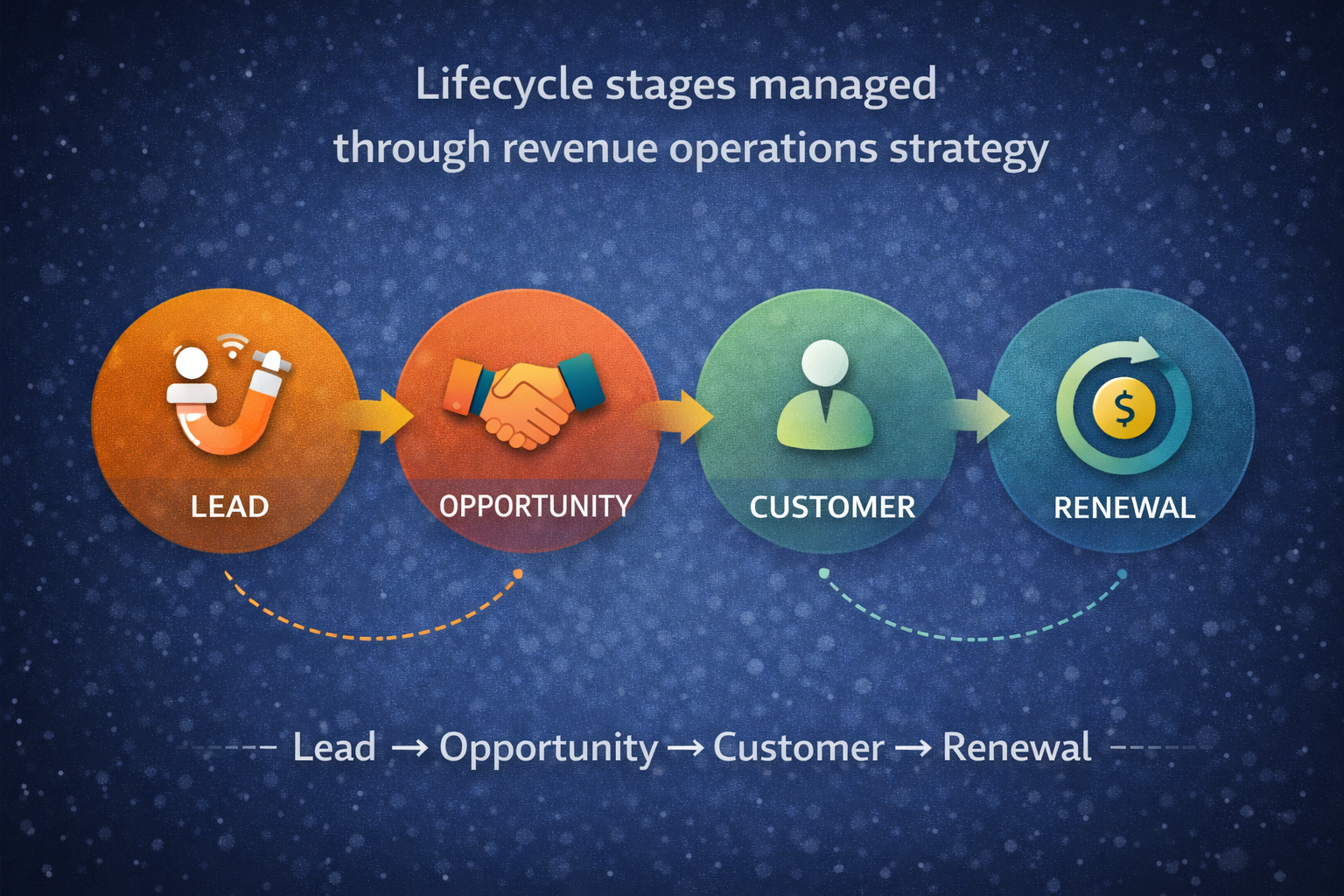
RevOps standardises lifecycle stages so performance can be improved systematically.
## Signs Your Business Needs RevOps
Many organisations “add RevOps” when they feel operational pain, but the better trigger is a pattern of revenue unpredictability. If you recognise several of the signals below, RevOps is likely a high leverage investment.
- Your forecast changes dramatically week to week, with no clear operational explanation.
- Sales and marketing disagree on what qualifies as a lead, an opportunity, or a healthy pipeline.
- CRM data is incomplete, inconsistent, or not trusted by leadership.
- Lead follow-up is inconsistent, and ownership is unclear across handoffs.
- Reporting requires manual spreadsheets and last-minute reconciliation.
- Revenue leakage shows up in discounting, approvals, billing handoffs, or onboarding delays.
- Your tech stack has grown, but outcomes have not improved.
A useful rule of thumb: if revenue performance depends on heroic effort and constant intervention, you do not have a stable revenue system. RevOps exists to remove the need for heroics.
## RevOps Is Not a Department. It Is an Operating Model.
RevOps is best understood as revenue architecture. It connects teams, systems, lifecycle stages and reporting into one operating model that makes growth measurable and repeatable. This is why RevOps is increasingly owned at leadership level: it influences forecasting confidence, investment decisions, and the organisation’s ability to scale without losing control.
The organisations that scale successfully are not simply adding more tools or pushing teams harder. They are designing revenue systems where data is trusted, handoffs are enforced, and performance is improved through operational clarity. That is what RevOps delivers: predictable growth built on a coherent revenue engine.
[](https://cta-redirect.hubspot.com/cta/redirect/6066958/7fa31ec4-2c12-4254-bc58-78d89b780ce8)
## Frequently Asked Questions About RevOps
### What is RevOps in simple terms?
RevOps is a framework for running revenue as one system. It aligns sales, marketing, customer success and finance around shared CRM data, consistent lifecycle stages, and unified reporting so growth becomes more predictable.
### Is RevOps only for SaaS companies?
No. RevOps is common in SaaS because recurring revenue and longer buyer journeys require operational clarity, but any B2B organisation with multiple channels, complex handoffs, or unreliable forecasting can benefit from a RevOps operating model.
### How long does it take to implement RevOps?
Timelines depend on complexity. Many organisations see meaningful improvements within 6 to 12 weeks by stabilising lifecycle definitions, CRM governance, and core reporting. Deeper operating model redesign can take several months, especially when quote-to-cash workflows are involved.
### What tools are used in RevOps?
RevOps typically includes a CRM (often HubSpot CRM), marketing automation, sales enablement tooling, reporting dashboards, and workflow automation. The most important “tool” is governance: shared definitions, enforced processes, and data quality standards.
### When should a company invest in RevOps?
Invest when growth becomes unpredictable: forecasts swing, pipeline cannot be trusted, and handoffs break between teams. RevOps is especially valuable during scale-up phases, restructures, tech stack expansion, or when leadership needs operational clarity for investment decisions.
## Subscribe
### Quick Lists
### Contact Us

**Head Office**
The Black Church, St. Mary's Place, Dublin, Ireland D07 P4AX
**South Africa**
25 Club Street, Linksfield, Johannesburg

[sales@velocitymedia.co.za](mailto:sales@velocitymedia.co.za)
-
-
-
-
### Services
- [Digital Campaign Strategy & Lead Generation](https://velocity.digital/digital-campaign-strategy-lead-generation)
- [Revenue Funnel Alignement](https://velocity.digital/revops-and-revenue-funnel-alignment)
- [CRM Implementation & Onboarding](https://velocity.digital/crm-implementation-onboarding)
- [AI Innovation & Automation](https://velocity.digital/process-and-workflow-automation)
- [Localised Marketing](https://velocity.digital/city-sites-joburg-and-pretoria)
### Useful Links
- [Contact Us](https://velocity.digital/contact)
- [Why choose velocity?](https://velocity.digital/why-choose-velocity)
- [Careers](https://velocity.digital/jobs)
- [Blog](https://velocity.digital/latest-news)
### Subscribe
Copyright © 2026. All Rights Reserved.
- [Privacy Policy](https://velocity.digital/privacy-policy)
- [Terms of use](https://velocity.digital/terms-of-use/)
- [PAIA Manual](https://velocity.digital/hubfs/Policy%20Documents/InfoReg_PAIA-Manual%20Velocity%20Media%20JAN%202024.pdf)

```json
{
"@context" : "https://schema.org",
"@type" : "BlogPosting",
"author" : {
"@type" : "Person",
"name" : "Shawn Greyling",
"url" : "https://velocity.digital/latest-news/author/shawn-greyling"
},
"dateModified" : "2026-02-27T09:19:04.569Z",
"datePublished" : "2026-02-27T09:19:04.000Z",
"headline" : "What Is RevOps? The Framework Behind Predictable Growth",
"image" : [ "https://velocity.digital/hubfs/Velocity%20Blog%20Featured%20Images-1.jpg" ],
"mainEntityOfPage" : {
"@id" : "https://velocity.digital/latest-news/what-is-revops-the-framework-behind-predictable-growth",
"@type" : "WebPage"
},
"publisher" : {
"@type" : "Organization",
"logo" : {
"@type" : "ImageObject",
"url" : "https://velocity.digital/hubfs/Untitled%20design-Apr-05-2024-07-12-12-3806-AM.png"
},
"name" : "Global Trolley (Pty) Ltd T/A Velocity Media"
}
}
```
```json
{
"@context" : "https://schema.org",
"@type" : "FAQPage",
"mainEntity" : [ {
"@type" : "Question",
"acceptedAnswer" : {
"@type" : "Answer",
"text" : "RevOps is a framework for running revenue as one system. It aligns sales, marketing, customer success and finance around shared CRM data, consistent lifecycle stages, and unified reporting so growth becomes more predictable."
},
"name" : "What is RevOps in simple terms?"
}, {
"@type" : "Question",
"acceptedAnswer" : {
"@type" : "Answer",
"text" : "No. RevOps is common in SaaS because recurring revenue and longer buyer journeys require operational clarity, but any B2B organisation with multiple channels, complex handoffs, or unreliable forecasting can benefit from a RevOps operating model."
},
"name" : "Is RevOps only for SaaS companies?"
}, {
"@type" : "Question",
"acceptedAnswer" : {
"@type" : "Answer",
"text" : "Timelines depend on complexity. Many organisations see improvements within 6 to 12 weeks by stabilising lifecycle definitions, CRM governance, and core reporting. Deeper redesign can take several months, especially when quote-to-cash workflows are involved."
},
"name" : "How long does it take to implement RevOps?"
}, {
"@type" : "Question",
"acceptedAnswer" : {
"@type" : "Answer",
"text" : "RevOps typically includes a CRM (often HubSpot CRM), marketing automation, sales enablement tooling, reporting dashboards, and workflow automation. The most important tool is governance: shared definitions, enforced processes, and data quality standards."
},
"name" : "What tools are used in RevOps?"
}, {
"@type" : "Question",
"acceptedAnswer" : {
"@type" : "Answer",
"text" : "Invest when growth becomes unpredictable: forecasts swing, pipeline cannot be trusted, and handoffs break between teams. RevOps is especially valuable during scale-up phases, restructures, tech stack expansion, or when leadership needs operational clarity."
},
"name" : "When should a company invest in RevOps?"
} ]
}
```