
AI is becoming part of everyday business conversations, but knowing where to start isn't always straightforward. With new tools, platforms and promises appearing almost daily, businesses are under increasing pressure to adopt AI without necessarily understanding where it will deliver the greatest value.
The good news is that getting started doesn't have to be complicated. By focusing on your business challenges, existing processes and measurable outcomes, you can identify AI opportunities that make sense for your operations, your people and your bottom line.
Covered in This Article
- Why AI adoption should start with a business problem
- Four questions to help prioritise AI opportunities
- What AI could look like across your business
- How to choose and measure your first AI project
- Frequently asked questions about getting started with AI
Why Your AI Strategy Should Start with a Business Problem
It's easy to get distracted by AI. A new platform promises to save your team hours of work, a competitor announces an AI-powered solution, or someone in marketing discovers a tool that could dramatically speed up content creation.
Before long, different departments are experimenting with different tools, but nobody is entirely sure what the business is getting out of it. Marketing might be using AI for content, sales could be testing automated meeting summaries, and operations may be exploring workflow automation. Individually, these initiatives might be useful, but without a shared direction, they rarely contribute to a bigger business objective.
The challenge isn't necessarily the technology. It's that the business hasn't clearly defined what it wants AI to achieve.
AI adoption should be driven by the problems worth solving, rather than the tools available to solve them. That means understanding where your business is losing time, where opportunities are being missed and which processes could benefit from improvement.
At Velocity, we believe the most effective AI strategies begin with a clear understanding of existing systems, processes and business objectives. Once those foundations are understood, identifying the right technology becomes a much more informed decision.
Before You Invest in AI, Ask These Four Questions
Not every business process needs AI, and not every AI opportunity deserves immediate attention. Before investing in another platform or launching a pilot project, it helps to evaluate potential opportunities against four practical criteria: impact, feasibility, risk and data readiness.
1. Impact: Will It Make a Meaningful Difference?
Start by identifying the business problem you're trying to solve and what improving that process could mean for your organisation.
Perhaps your sales team spends too much time manually qualifying leads, customer service is overwhelmed by repetitive enquiries, or marketing struggles to turn campaign data into actionable insights. These are all potential opportunities, but their value depends on the results they could deliver.
Rather than focusing exclusively on time savings, consider how an improvement might influence productivity, customer experience, operational costs or revenue. The strongest AI opportunities are those connected to measurable business outcomes.
2. Feasibility: Can Your Business Make It Work?
An AI solution might look impressive in a demonstration, but implementing it within your business is another matter.
Before committing, consider whether your existing systems can support the solution, whether your team has the necessary skills and whether the process itself is clearly defined. A workflow that relies on inconsistent manual steps or disconnected systems may need attention before AI can be introduced effectively.
This is also where it's worth distinguishing between AI and traditional automation. Some business challenges can be solved through relatively straightforward workflow improvements without introducing AI at all.
The objective should always be to find the most appropriate solution, rather than the most sophisticated one.
3. Risk: What Happens When AI Gets Something Wrong?
AI can improve efficiency and support decision-making, but it isn't infallible. Understanding the potential consequences of an error is an important part of choosing where to begin.
For example, using AI to summarise internal meetings carries a different level of risk from allowing it to respond directly to customers or make recommendations based on sensitive financial information.
Businesses should consider the accuracy of outputs, access to customer information, regulatory requirements and the level of human oversight needed. Higher-risk applications may still offer significant value, but they generally require stronger safeguards and more careful implementation.
4. Data: Is Your Information Ready?
AI depends on the quality and accessibility of the information supporting it. If customer records are incomplete, systems aren't connected or reporting is unreliable, introducing AI may amplify existing problems rather than resolve them.
That doesn't mean your business needs a perfect database before getting started. It does mean understanding which information a particular AI solution requires and whether that information is sufficiently accurate, accessible and appropriately governed.
For businesses using a CRM, this is especially important. Customer information often sits at the centre of marketing, sales and service processes, making data quality a critical consideration when introducing AI.
If your CRM data needs attention, our article on why your HubSpot CRM data is unreliable and how to fix it offers a useful starting point.
What Does This Look Like in Practice?
Imagine your business is considering three AI initiatives: automating lead qualification, introducing a customer service chatbot and using AI to summarise meetings.
Each opportunity has potential, but they differ in terms of business impact, implementation requirements and risk. A simple assessment can help leadership teams compare these initiatives before deciding where to invest.
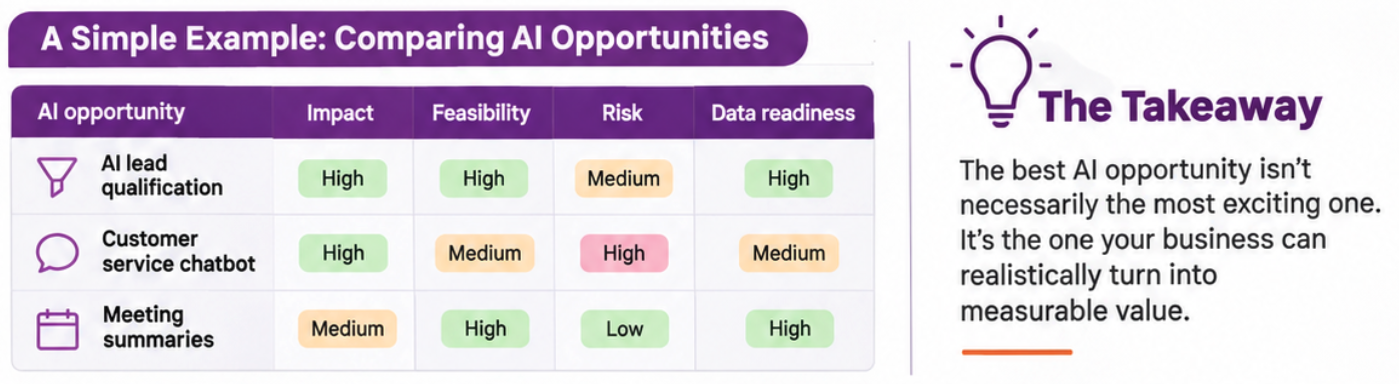 This is an illustrative example. Actual assessments will depend on your business, systems and available data.
In this scenario, AI-powered lead qualification could be a strong starting point because it addresses a measurable business need and the supporting data is already available. Meeting summaries might offer an easier, lower-risk productivity improvement, while a customer service chatbot could require additional preparation to ensure it delivers accurate, consistent responses.
The purpose of this exercise isn't to create a complicated scoring system. It's to encourage better conversations about where AI could deliver value and what needs to be in place before implementation.
The best AI opportunity isn't necessarily the most exciting one. It's the one your business can realistically turn into measurable results.
Where Could AI Make a Difference in Your Business?
You don't need to reinvent your entire operation to benefit from AI. In many cases, the most valuable opportunities exist within everyday processes that your teams already manage.
Marketing teams can use AI to support content planning, audience segmentation, campaign analysis and reporting. Beyond producing content more efficiently, AI can help marketers identify patterns, understand performance and make more informed decisions about where to focus their efforts.
Sales teams can benefit from AI-assisted lead prioritisation, meeting summaries and customer interaction analysis. When implemented effectively, these capabilities can reduce administrative work, improve follow-up processes and give salespeople more time to focus on building relationships and closing opportunities.
Customer service teams can use AI to assist with routine enquiries, categorise incoming requests and direct customers to the appropriate resources or team members. The objective is to improve response times and service consistency while ensuring human support remains available when needed.
Operations teams can explore AI for reporting, information processing and repetitive administrative tasks. When combined with well-designed workflows, these applications can reduce manual effort and improve consistency across departments.
However, these opportunities become significantly more valuable when they form part of a connected business environment. Your CRM, data and existing automation processes all influence how successfully AI can be introduced.
This is where a strong Revenue Operations (RevOps) strategy becomes particularly relevant. By aligning people, processes and technology across departments, businesses can create a more reliable foundation for AI adoption.
Introducing AI into disconnected systems doesn't automatically create a connected business. In many cases, improving how your existing systems work together is the first step towards making AI genuinely useful.
Your First AI Project Should Prove Value, Not Just Possibility
One of the most common misconceptions about AI adoption is that businesses need to launch large-scale initiatives to see meaningful results. In reality, a focused project with a clear objective can provide far more useful insight than several experiments running simultaneously.
A practical starting point is to choose one process that your business understands well, identify the improvement you're hoping to achieve and assign someone to take responsibility for the outcome.
Before implementation, establish five things:
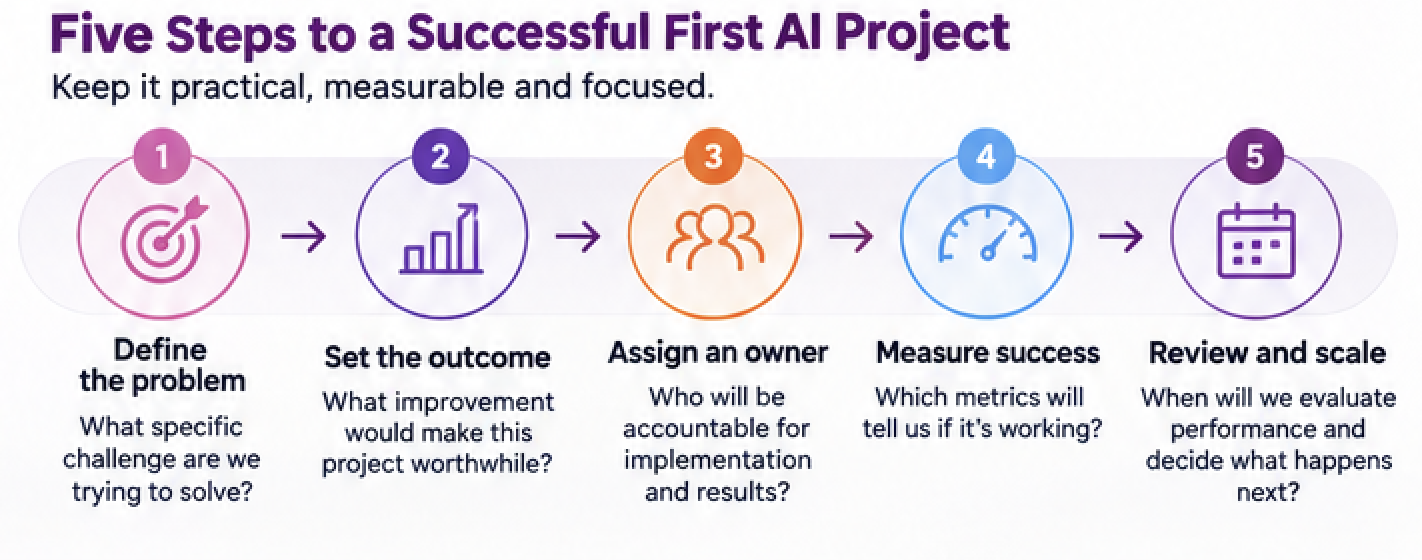
For example, if your sales team spends several hours each week manually reviewing incoming leads, you could introduce AI-assisted qualification within one team for an initial 90-day period.
During that time, you could measure how much administrative work has been reduced, whether lead recommendations are accurate and whether qualified prospects are being contacted more quickly. These results would help determine whether the solution should be refined, expanded or reconsidered.
This approach allows businesses to learn from implementation without committing to unnecessary complexity or expense. It also creates a stronger business case for future investment because decisions are supported by measurable evidence rather than assumptions.
So, Where Should Your Business Start with AI?
The most useful place to begin is often with the challenges your business already knows it has. Repetitive tasks, disconnected systems, delayed customer responses and missed opportunities can all provide clues about where technology might make a meaningful difference.
From there, the priority should be identifying which opportunities offer the greatest potential impact, are realistic to implement and can be supported by your existing processes and data.
AI adoption doesn't have to happen all at once, and it certainly doesn't need to involve every department from day one. A well-chosen first project can help your business build confidence, understand the practical requirements and develop a clearer roadmap for future initiatives.
Ultimately, the businesses that benefit most from AI won't necessarily be those using the greatest number of tools. They'll be the ones that understand how to apply technology to achieve meaningful business outcomes.
At Velocity, we help businesses move beyond AI experimentation by assessing their existing processes, CRM systems and data to identify practical opportunities for improvement. Our AI Readiness Assessment & Strategy is designed to help you understand where your business stands, which opportunities are worth pursuing and how to approach implementation with a clear plan.

Frequently Asked Questions
1. Where should a business start with AI?
The best starting point is to identify a specific business problem that AI could help solve. Focus on opportunities that offer measurable value, manageable risks and realistic implementation requirements. Starting with one well-defined project allows your business to build experience and evaluate results before expanding its AI initiatives.
2. How do you know if your business is ready for AI?
AI readiness depends on several factors, including the clarity of your business processes, the quality of your data, the capabilities of your existing systems and your team's ability to manage new technology. You don't need everything to be perfect, but you should understand what you're trying to achieve and what resources are required to make it work.
3. Do you need clean data before implementing AI?
You don't need a perfect database, but the information supporting your chosen AI solution should be reliable enough for its intended purpose. If an application depends on incomplete, outdated or inconsistent records, addressing those issues first can significantly improve the likelihood of a successful implementation. Our guide to first-party data explores why reliable customer information matters.
4. Who should be responsible for AI adoption?
AI initiatives should have a clearly defined business owner who is accountable for the outcomes. Depending on the project, this could be someone in operations, marketing, sales or senior leadership. IT, CRM and data teams should also be involved where system integrations, information security and data governance are concerned.
5. What are the biggest mistakes businesses make when adopting AI?
Common mistakes include investing in tools without clear objectives, launching too many disconnected experiments, overlooking data quality and failing to assign ownership. Businesses can reduce these risks by evaluating opportunities carefully, starting with manageable projects and measuring results before scaling their investment. For more context on responsible adoption, read our article on navigating global AI regulations.